

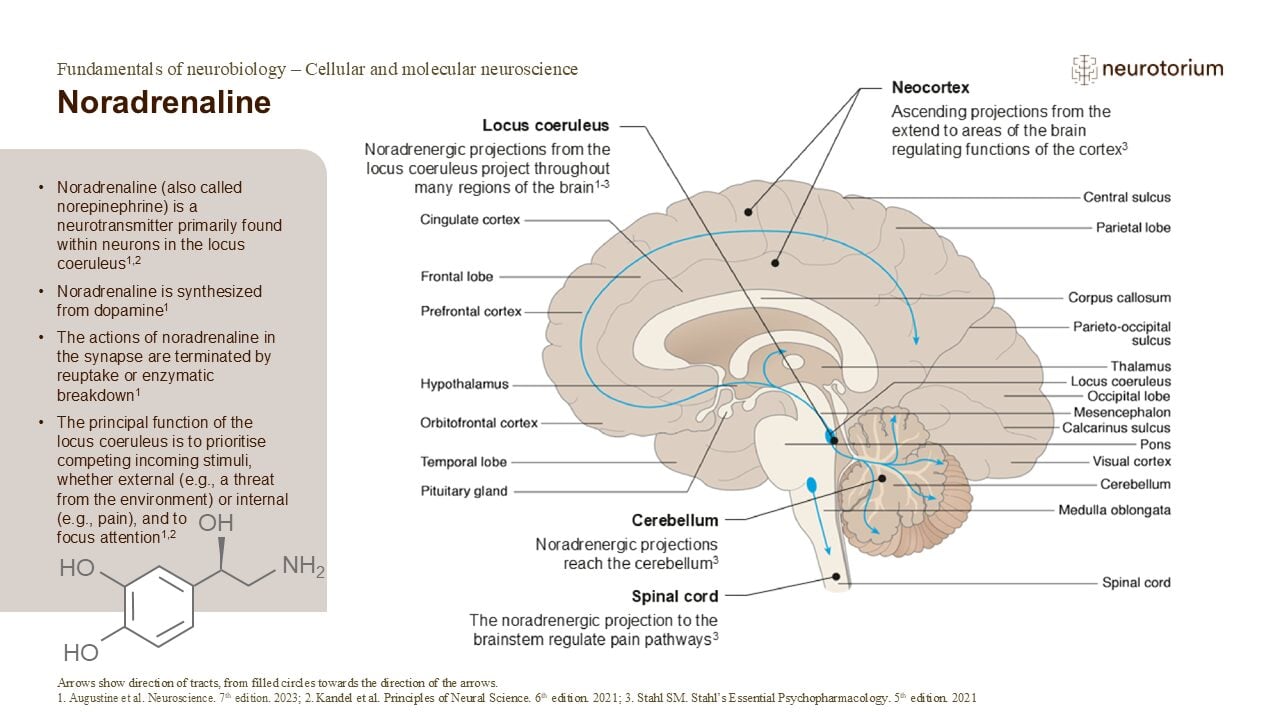
Noradrenergic neurons project widely throughout the brain, and there are many brain areas where serotonin, noradrenaline and dopamine projections overlap, allowing interactions between these transmitter systems.1,4
Noradrenaline and the locus coeruleus are thought to have important input into the control the CNS exerts over cognition, memory, stress response, arousal, pain, and other functions.5-7 Malfunction of the locus coeruleus is thought to underlie disorders such as depression, anxiety, and Alzheimer’s disease, and Parkinson’s disease.5 In addition, abnormalities in the noradrenergic projection to the hypothalamus – which mediates stress response – are thought to be involved in the pathology of depressive and anxiety disorders.8
References:
1. Neurotransmitters. In: Augustine GJ, Groh J, Huettel S, et al. (eds). Neuroscience. 7th edition. Oxford University Press, 2023.
2. Neurotransmitters. In: Kandel ER, Koester JD, Mack SH, Siegelbaum SA (eds). Principles of Neural Science. 6th edition. McGraw-Hill, 2021.
3. Stahl SM. Psychosis, schizophrenia, and the neurotransmitters networks dopamine, serotonin, and glutamate. In: Stahl’s Essential Psychopharmacology. Neuroscientific Basis and Practical Applications. 5th edition. © Cambridge University Press, 2021.
4. Blier P, Briley M. The noradrenergic symptom cluster: clinical expression and neuropharmacology. Neuropsychiatr Dis Treat 2011; 7 (Suppl 1): 15–20.
5. Khroud NK, Reddy V, Saadabadi A. Neuroanatomy, locus coeruleus. StatPearls [internet]. 2022.
6. Hussain LS, Reddy V, Maani CV. Physiology, noradrenergic synapse. StatPearls [internet]. 2023.
7. Taylor BK, Westlund KN. The noradrenergic locus coeruleus as a chronic pain generator. J Neurosci Res 2017; 95 (6): 1336–1346.
8. Dunn AJ, Swiergiel AH. The role of corticotropin-releasing factor and noradrenaline in stress-related responses, and the inter-relationships between the two systems. Eur J Pharmacol 2008; 583 (2–3): 186–193.