References:
1. Neurotransmitters. In: Augustine GJ, Groh J, Huettel S, et al. (eds). Neuroscience. 7th edition. Oxford University Press, 2023.
2. Wei CJ, Li W, Chen JF. Normal and abnormal functions of adenosine receptors in the central nervous system revealed by genetic knockout studies. Biochim Biophys Acta 2011; 1808 (5): 1358–1379.
3. Burnstock G. Introductory overview of purinergic signalling. Front Biosci (Elite Ed) 2011; 3 (3): 896–900.
4. Stockwell J, Jakova E, Cayabyab FS. Adenosine A1 and A2A receptors in the brain: current research and their role in neurodegeneration. Molecules 2017; 22 (4): 676.
5. Zarrinmayeh H, Territo PR. Purinergic receptors of the central nervous system: Biology, PET ligands, and their applications. Mol Imaging 2020; 19: 1536012120927609.
6. Vincenzi F, Pasquini S, Contri C, et al. Pharmacology of adenosine receptors: recent advancements. Biomolecules 2023; 13 (9): 1387.
7. Cisneros-Mejorado A, Pérez-Samartín A, Gottlieb M, Matute C. ATP signaling in brain: release, excitotoxicity and potential therapeutic targets. Cell Mol Neurobiol 2015; 35 (1): 1–6.
8. Neurotransmitters and Overview of synaptic transmission. In: Kandel ER, Koester JD, Mack SH, Siegelbaum SA (eds). Principles of Neural Science. 6th edition. McGraw-Hill, 2021.
9. Del Puerto A, Wandosell F, Garrido JJ. Neuronal and glial purinergic receptors functions in neuron development and brain disease. Front Cell Neurosci 2013; 7: 197.
10. Huang L, Zhu W, Li N, et al. Functions and mechanisms of adenosine and its receptors in sleep regulation. Sleep Med 2024; 115: 210–217.
11. Ali AAH, Avakian GA, Gall CV. The role of purinergic receptors in the circadian system. Int J Mol Sci 2020; 21 (10): 3423.
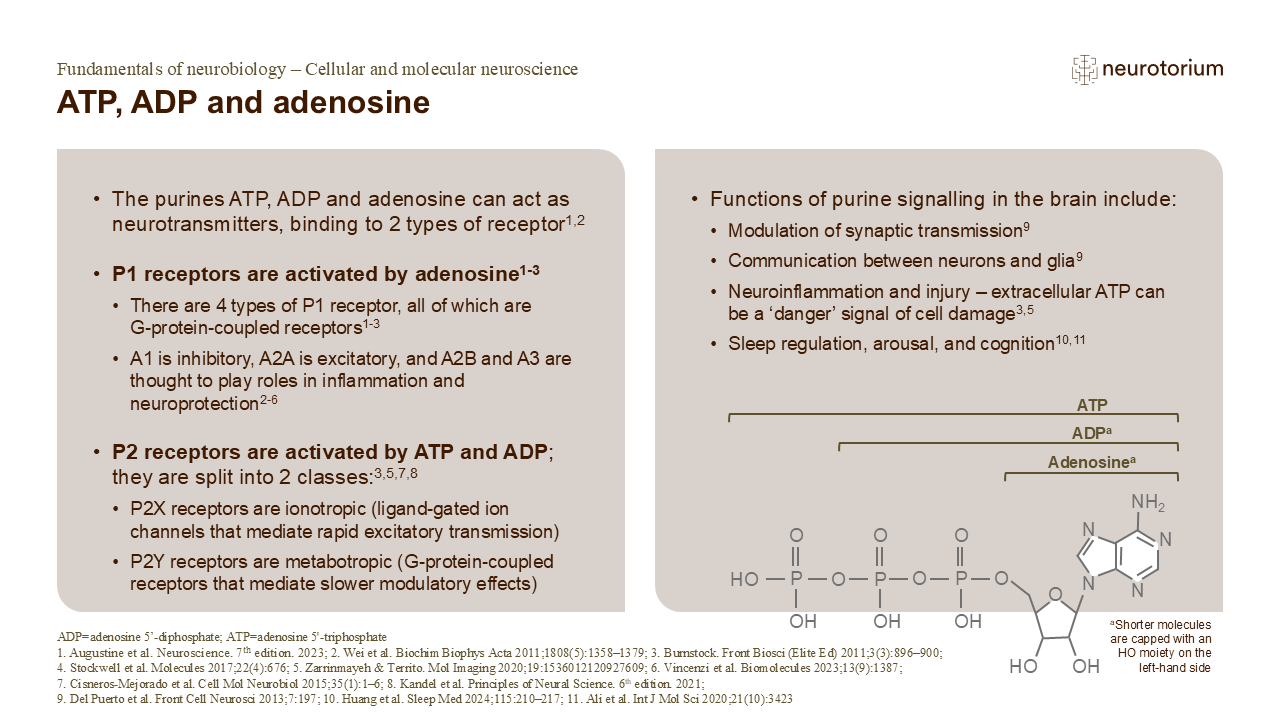
ATP, ADP and adenosine