

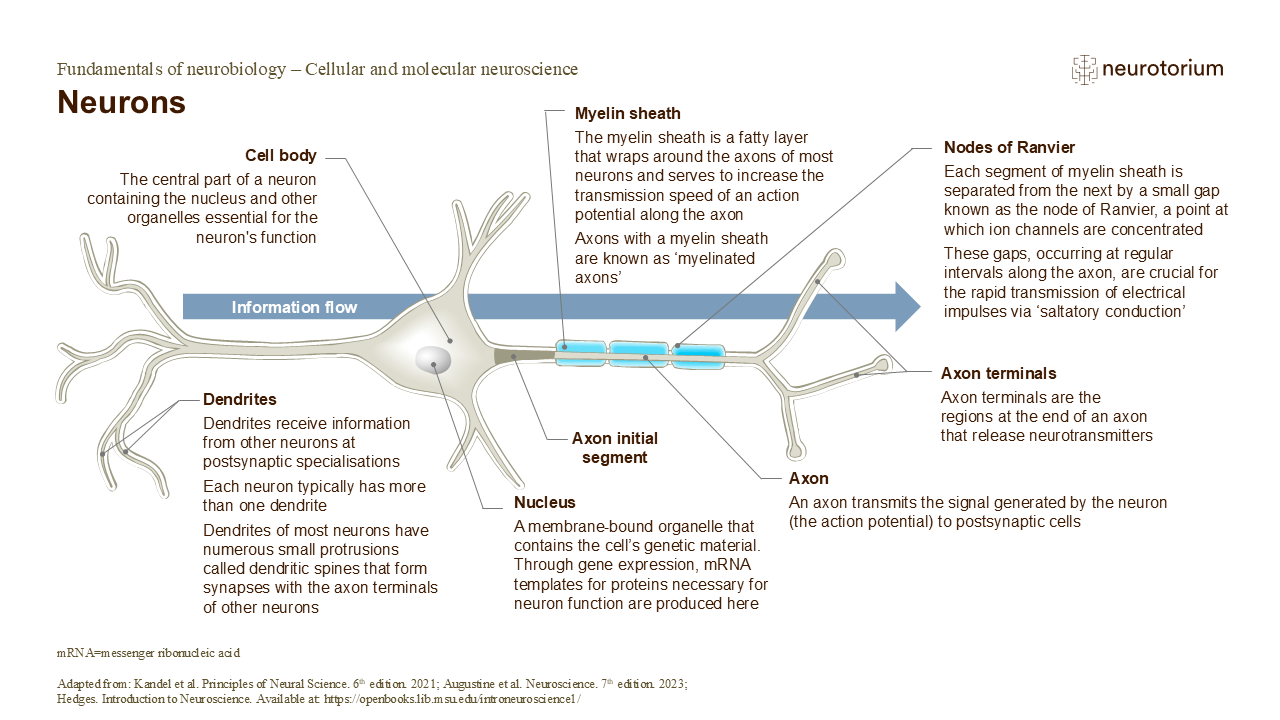
The neuron constitutes the functional unit of the nervous system, and there are many billions of neurons in the brain.1,4,5 Each neuron has the ability to connect with up to a thousand other neurons via specialized sites of communication called synapses, creating complex neural circuits.1,2 A simplified neuron is shown on the slide, along with explanations of its various component parts.1
References:
1. Nerve cells, neural circuitry, and behavior. In: Kandel ER, Koester JD, Mack SH, Siegelbaum SA (eds). Principles of Neural Science. 6th edition. McGraw-Hill, 2021.
2. Studying the nervous system. In: Augustine GJ, Groh J, Huettel S, et al. (eds). Neuroscience. 7th edition. Oxford University Press, 2023.
3. Hedges V. Cells of the nervous system: the neuron. In: Introduction to Neuroscience. Available at: https://openbooks.lib.msu.edu/introneuroscience1/. Michigan State University Libraries.
4. Azevedo FA, Carvalho LR, Grinberg LT, et al. Equal numbers of neuronal and nonneuronal cells make the human brain an isometrically scaled-up primate brain. J Comp Neurol 2009; 513 (5): 532–541.
5. Herculano-Houzel S. The human brain in numbers: a linearly scaled-up primate brain. Front Hum Neurosci 2009; 3: 31.