

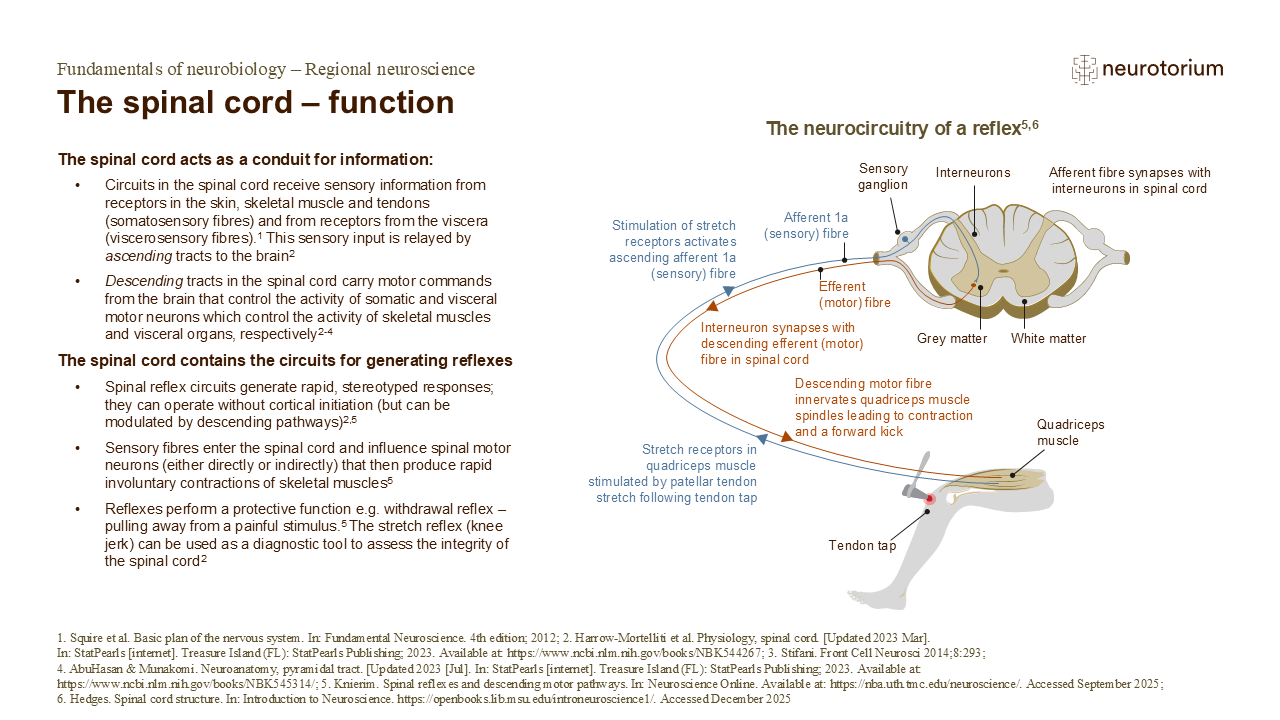
Because so many important functions are concentrated into such a small region of the CNS, injury to the spinal cord can cause devastating neurological impairment.2 Damage to the thoracic spinal cord can produce paraplegia (paralysis of both legs), and loss of bowel and bladder control.2 Damage to the cervical spinal cord results in quadriplegia (paralysis of arms and legs).2 Such damage is generally irreversible because the CNS in contrast to the PNS has severely limited ability to regenerate.7
References:
1. Basic plan of the nervous system. In: Squire L, Berg D, Bloom FE, Lac Sd, Ghosh A, Spitzer NC. Fundamental Neuroscience. 4th edition, 2012. Burlington: Elsevier Science.
2. Harrow-Mortelliti M, Reddy V, Jimsheleishvili G. Physiology, spinal cord. [Updated 2023 Mar]. In: StatPearls [internet]. Treasure Island (FL): StatPearls Publishing; 2023. Available at: https://www.ncbi.nlm.nih.gov/books/NBK544267.
3. Stifani N. Motor neurons and the generation of spinal motor neuron diversity. Front Cell Neurosci 2014; 8: 293.
4. AbuHasan Q, Munakomi S. Neuroanatomy, pyramidal tract. [Updated 2023 [Jul]. In: StatPearls [internet]. Treasure Island (FL): StatPearls Publishing; 2023. Available at: https://www.ncbi.nlm.nih.gov/books/NBK545314/.
5. Knierim J. Spinal reflexes and descending motor pathways. In: Neuroscience Online. Available at: https://nba.uth.tmc.edu/neuroscience/. Accessed September 2025.
6. Hedges V. Spinal cord structure. In: Introduction to Neuroscience. Available at: https://openbooks.lib.msu.edu/introneuroscience1/. Accessed December 2025.
7. Kvistad CE, Kråkenes T, Gavasso S, Bø L. Neural regeneration in the human nervous system – from understanding the underlying mechanisms to developing treatments. Where do we stand today? Front Neurol 2024; 15: 1398089.