

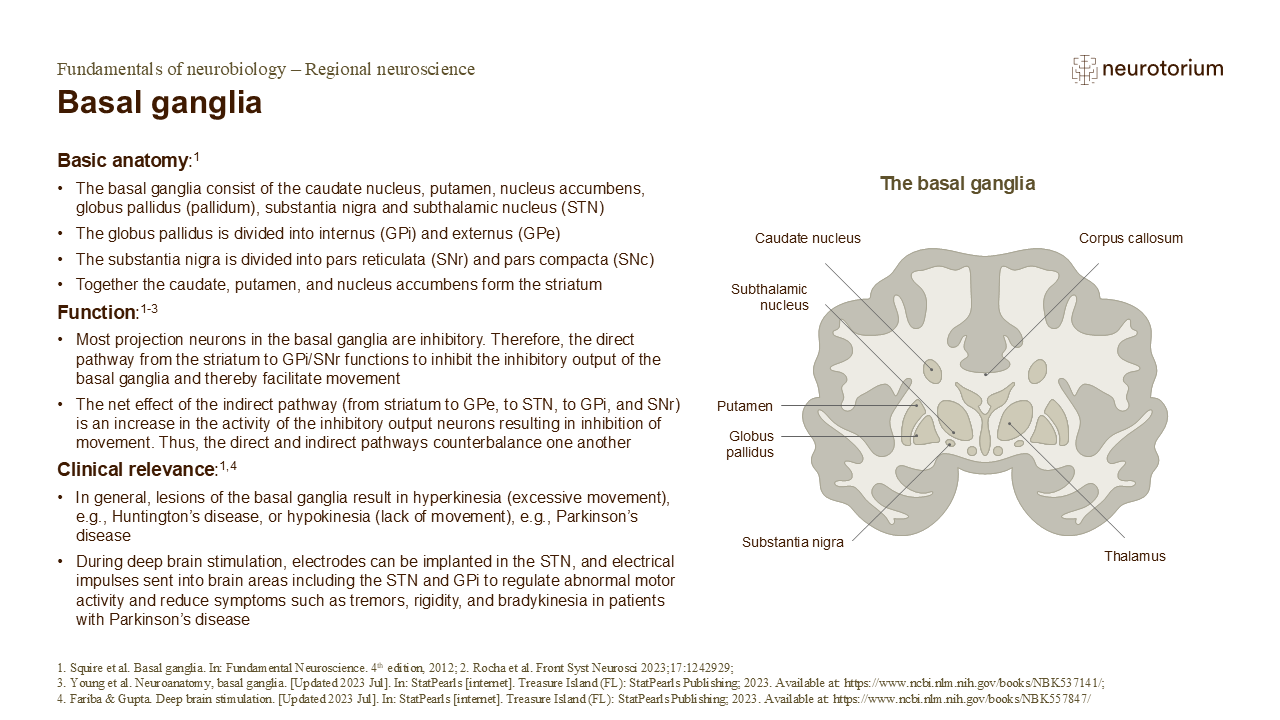
The basal ganglia are a group of subcortical nuclei that are important in motor control.1
Pathways:
- The caudate and putamen (striatum) the main input structures of the basal ganglia. GPi and SNr are the main output structures1,2
- Basal ganglia receives excitatory input from virtually all regions of the cortex. Sensory, motor, association and limbic areas of cortex all project to striatum1
- The major output from the basal ganglia is to the portions of the thalamus that project to prefrontal, premotor and motor cortex1,3
- The basal ganglia do not project directly to the spinal cord, therefore their effects on movement are indirect mediated by their connections between the thalamus and cortex.1,3
- There are two main pathways through the basal ganglia: the direct pathway is a direct connection from the striatum to GPi/SNr. The second, indirect pathway is from striatum to GPe to subthalamic nucleus to GPi/SNr1,2
References:
1. The basal ganglia. In: Squire L, Berg D, Bloom FE, Lac Sd, Ghosh A, Spitzer NC. Fundamental Neuroscience. 4th edition, 2012. Burlington: Elsevier Science.
2. Rocha GS, Freire MAM, Britto AM, et al. Basal ganglia for beginners: the basic concepts you need to know and their role in the control of movement. Front Syst Neurosci 2023; 17: 1242929.
3. Young CB, Reddy V, Sonne J. Neuroanatomy, basal ganglia. [Updated 2023 Jul]. In: StatPearls [internet]. Treasure Island (FL): StatPearls Publishing; 2023. Available at: https://www.ncbi.nlm.nih.gov/books/NBK537141/.
4. Fariba KA, Gupta V. Deep brain stimulation. [Updated 2023 Jul]. In: StatPearls [internet]. Treasure Island (FL): StatPearls Publishing; 2023. Available at: https://www.ncbi.nlm.nih.gov/books/NBK557847/.