

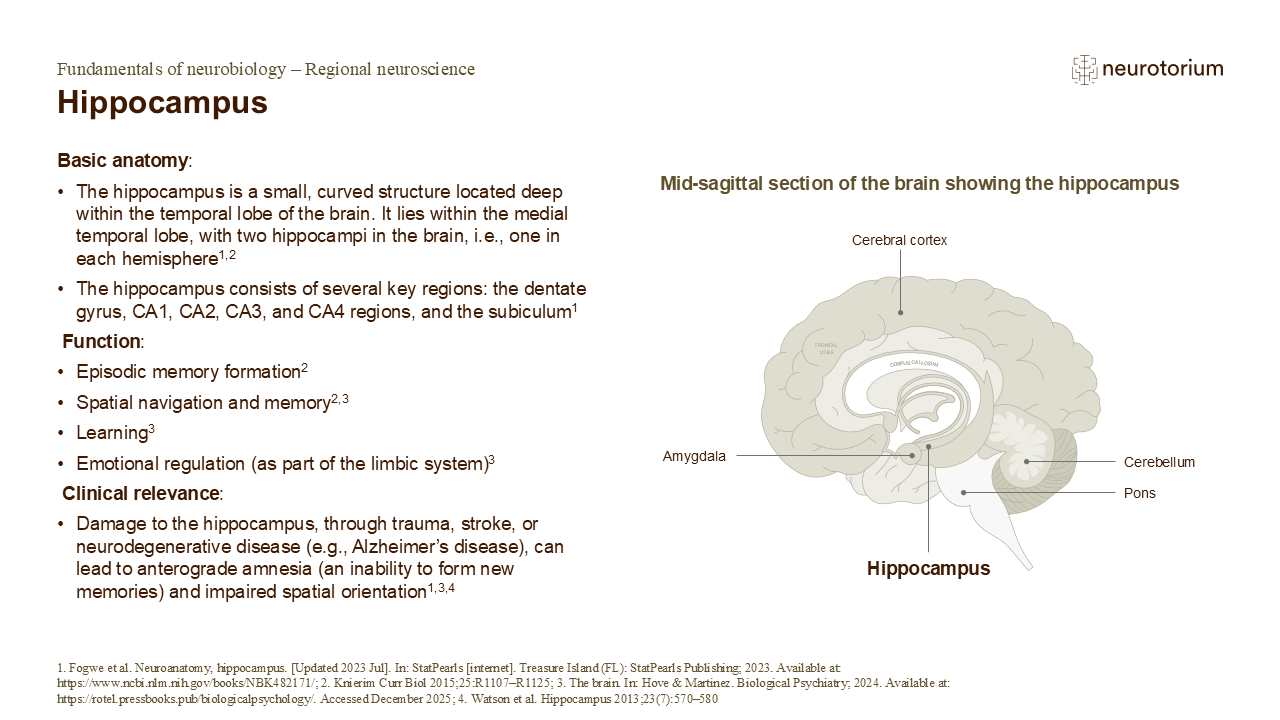
Structure continued:
- The dentate gyrus is a key region that plays a role in forming new memories and in neurogenesis5
- The CA1 and CA3 regions are subfields responsible for the processing and relay of information, particularly in memory formation and retrieval6
- The subiculum is a transitional zone between the hippocampus and other brain regions, contributing to the output of the hippocampal network7
The hippocampus is functionally involved in:
- Memory formation: the hippocampus is essential for converting short-term memories into long-term memories (a process known as memory consolidation).8 This is particularly important for explicit or declarative memory, which involves memories of facts, events, and experiences2
- Spatial navigation and memory: the hippocampus is crucial for spatial memory and navigation.3 It helps in forming mental maps of the environment, enabling individuals to remember locations and navigate through spaces9
- Learning: the hippocampus is involved in learning, especially the formation of new associations and the ability to understand relationships between different pieces of information9
- Emotional regulation: while not directly responsible for emotions, the hippocampus interacts with other parts of the limbic system (such as the amygdala) to regulate emotional responses, particularly those tied to memories10
References:
1. Fogwe LA, Reddy V, Mesfin FB. Neuroanatomy, hippocampus. [Updated 2023 Jul]. In: StatPearls [internet]. Treasure Island (FL): StatPearls Publishing; 2023. Available at: https://www.ncbi.nlm.nih.gov/books/NBK482171/.
2. Knierim JJ. The hippocampus. Curr Biol 2015; 25: R1107–R1125.
3. The brain. In: Hove M, Martinez SA. Biological Psychiatry; 2024. Available at: https://rotel.pressbooks.pub/biologicalpsychology/. Accessed December 2025.
4. Watson PD, Voss JL, Warren DE, et al. Spatial reconstruction by patients with hippocampal damage is dominated by relational memory errors. Hippocampus 2013; 23 (7): 570–580.
5. Hainmueller T, Bartos M. Dentate gyrus circuits for encoding, retrieval and discrimination of episodic memories. Nat Rev Neurosci 2020; 21 (3): 153–168.
6. Langston RF, Stevenson CH, Wilson CL, et al. The role of hippocampal subregions in memory for stimulus associations. Behav Brain Res 2010; 215 (2): 275–291.
7. Douglass NP, Willis MA, Haines DE. The limbic system. In: Haines DE, Mihailoff GA, Willis MA. Fundamental Neuroscience for Basic and Clinical Applications. 6th edition, 2025. Philadelphia: Elsevier.
8. Almaraz-Espinoza A, Grider MH. Physiology, long term memory. [Updated 2023 Jul]. In: StatPearls [internet]. Treasure Island (FL): StatPearls Publishing; 2023. Available at: https://www.ncbi.nlm.nih.gov/books/NBK549791/.
9. Bird CM, Burgess N. The hippocampus and memory: insights from spatial processing. Nat Rev Neurosci 2008; 9 (3): 182–194.
10. Song J. Amygdala activity and amygdala-hippocampus connectivity: Metabolic diseases, dementia, and neuropsychiatric issues. Biomed Pharmacother 2023; 162: 114647.