

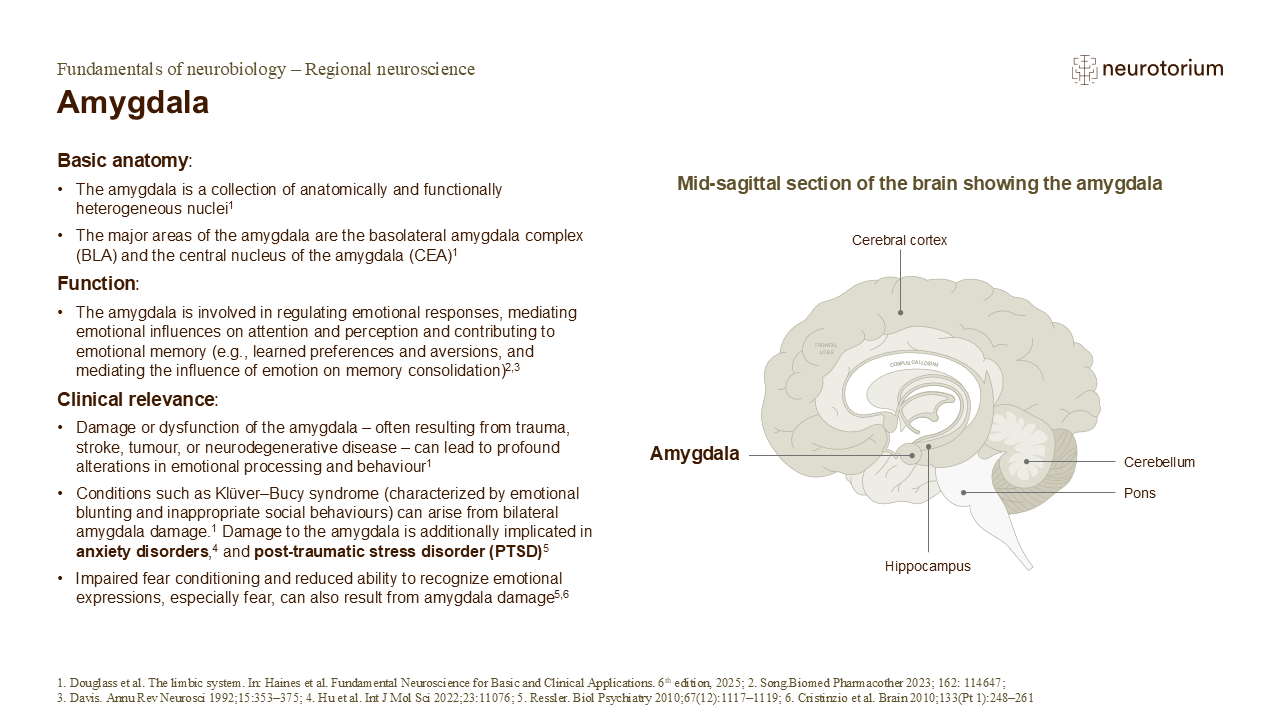
Structure continued:
- The BLA receives input from widespread cortical areas as well as from sensory nuclei of the thalamus.1,7 It therefore has access to high-level information from association areas as well as lower-level sensory information7
- The BLA projects to the CEA which has outputs to subcortical areas controlling a broad range of fear-related behaviours including autonomic and motor responses (heart rate, blood pressure, startle response)8
References:
1. Douglass NP, Willis MA, Haines DE. The limbic system. In: Haines DE, Mihailoff GA, Willis MA. Fundamental Neuroscience for Basic and Clinical Applications. 6th edition, 2025. Philadelphia: Elsevier.
2. Song J. Amygdala activity and amygdala-hippocampus connectivity: Metabolic diseases, dementia, and neuropsychiatric issues. Biomed Pharmacother 2023; 162: 114647.
3. Davis M. The role of the amygdala in fear and anxiety. Annu Rev Neurosci 1992; 15: 353–375.
4. Hu P, Lu Y, Pan B, Zhang W. New insights into the pivotal role of the amygdala in inflammation-related depression and anxiety disorder. Int J Mol Sci 2022; 23: 11076.
5. Ressler KJ. Amygdala activity, fear, and anxiety: modulation by stress. Biol Psychiatry 2010; 67 (12): 1117–1119.
6. Cristinzio C, N’Diaye K, Seeck M, et al. Integration of gaze direction and facial expression in patients with unilateral amygdala damage. Brain 2010; 133 (Pt 1): 248–261.
7. Sepahvand T, Power KD, Qin T, Yuan Q. The basolateral amygdala: the core of a network for threat conditioning, extinction, and second-order threat conditioning. Biology 2023; 12: 1274.
8. Keifer OP Jr., Hurt RC, Ressler KJ, Marvar PJ. The physiology of fear: Reconceptualizing the role of the central amygdala in fear learning. Physiology 2015; 30 (5): 391–401.