

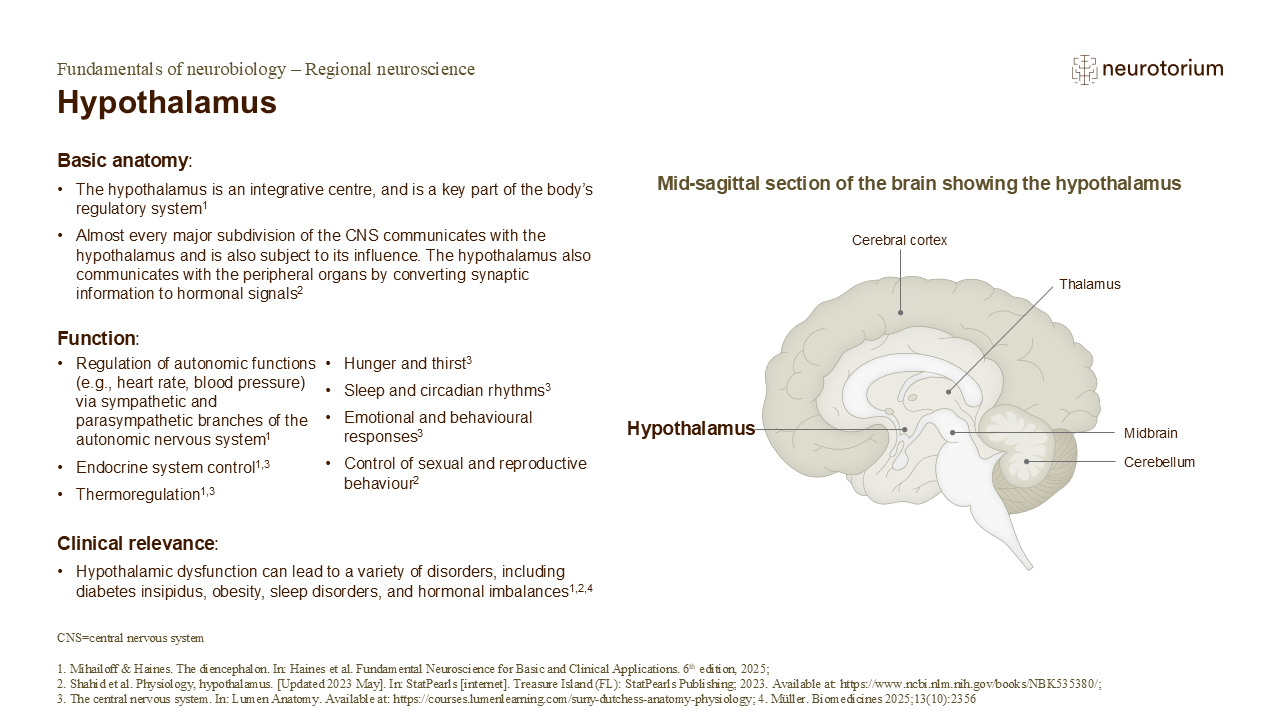
Regulation of autonomic functions: heart rate, blood pressure, and digestion are regulated by the hypothalamus, via its influence on the sympathetic and parasympathetic branches of the autonomic nervous system.1,3
Endocrine system control: The hypothalamus connects the nervous system to the endocrine system via the pituitary gland.1 It produces releasing and inhibiting hormones that regulate the secretion of hormones from the pituitary, which in turn controls other endocrine glands (e.g., thyroid, adrenal glands, and reproductive organs).2 Examples of hypothalamic hormones include oxytocin and vasopressin: synthesised in the hypothalamus and stored in the posterior pituitary, these hormones are involved in childbirth, lactation, and water balance.1,2
Thermoregulation: The hypothalamus monitors and regulates body temperature.2 It responds to changes in internal and external temperatures by initiating processes like sweating, shivering, and altering blood flow to the skin to maintain an optimal core temperature.3,5
Hunger and thirst: The hypothalamus plays a key role in regulating hunger and thirst through specific nuclei.3 Activation of the lateral hypothalamus, stimulates hunger and feeding behaviour, while activation the ventromedial hypothalamus signals satiety.1,6
Sleep and circadian rhythms: The hypothalamus helps regulate sleep patterns and circadian rhythms through its control of the suprachiasmatic nucleus (SCN), which is the body’s internal clock.1
Emotional and behavioural responses: The hypothalamus plays a role in emotional expression (such as anger and pleasure) and influences sexual behaviour, aggression, and stress responses.3
Control of sexual and reproductive behaviour: The hypothalamus regulates reproduction through the release of gonadotropin-releasing hormone (GnRH), which controls the release of hormones from the anterior pituitary that modulate reproductive organ function and development.7
References:
1. Mihailoff GA, Haines DE. The diencephalon. In: Haines DE, Mihailoff GA, Willis MA. Fundamental Neuroscience for Basic and Clinical Applications. 6th edition, 2025. Philadelphia: Elsevier.
2. Shahid et al. Physiology, hypothalamus. [Updated 2023 May]. In: StatPearls [internet]. Treasure Island (FL): StatPearls Publishing; 2023. Available at: https://www.ncbi.nlm.nih.gov/books/NBK535380/.
3. The central nervous system. In: Lumen Anatomy. Available at: https://courses.lumenlearning.com/suny-dutchess-anatomy-physiology.
4. Müller HL. Sleep disorders, dysregulation of circadian rhythms, and fatigue after craniopharyngioma – A narrative review. Biomedicines 2025; 13 (10): 2356.
5. Osilla EV, Marsidi JL, Shumway KR, Sharma S. Physiology, temperature regulation. [Updated 2023 Jul]. In: StatPearls [internet]. Treasure Island (FL): StatPearls Publishing; 2023. Available at: https://www.ncbi.nlm.nih.gov/books/NBK507838/.
6. Kongstorp M, Karnani MM, McCutcheon JE. Does the lateral hypothalamus govern the transition between appetitive and consummatory feeding? Neuropharmacology 2025; 275: 110438.
7. Hormonal control of human reproduction. In: State University of New York. Biology for Majors II. Available at: https://courses.lumenlearning.com/suny-wmopen-biology2/chapter/hormonal-control-of-human-reproduction/.