

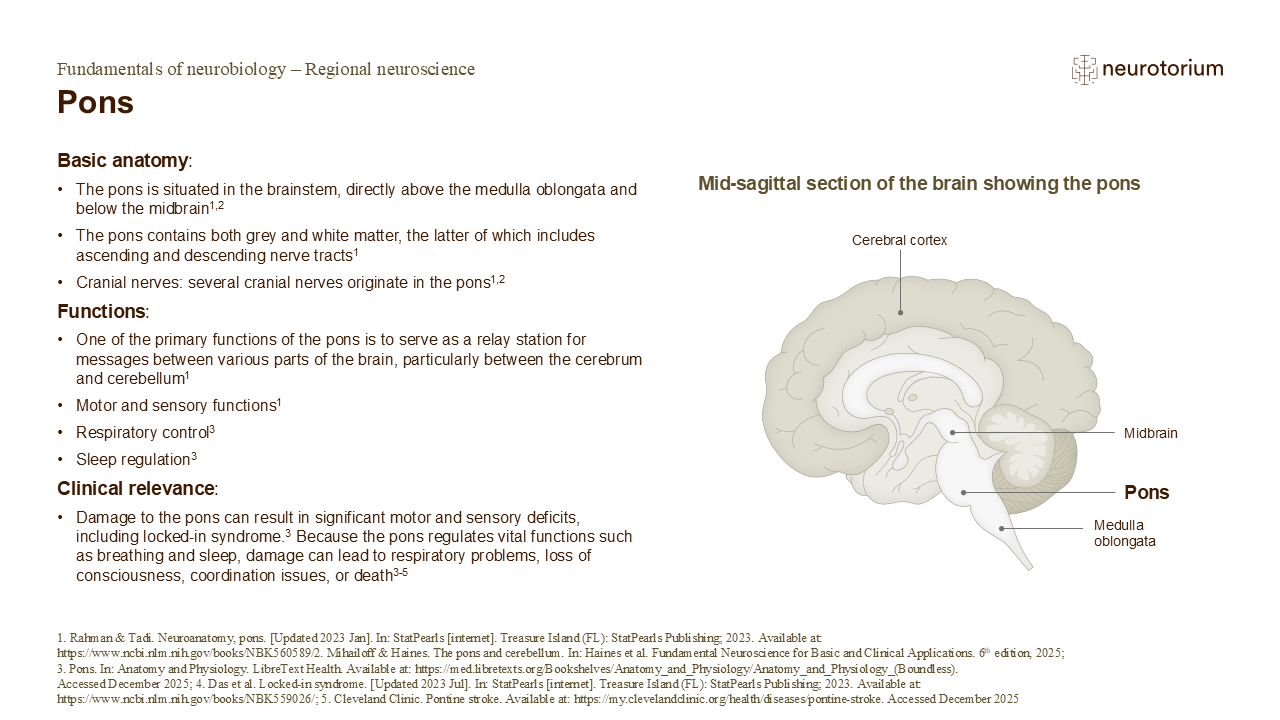
Several cranial nerves originate in the pons, including:2,6
- The trigeminal nerve (V) – responsible for sensation in the face and motor functions like biting and chewing
- The abducens nerve (VI) – controls the lateral rectus responsible for lateral eye movement
- The facial nerve (VII) – controls facial muscles, taste and secretion by salivary and lacrimal glands
- The vestibulocochlear nerve (VIII) – associated with hearing and balance
References:
1. Rahman M, Tadi P. Neuroanatomy, pons. [Updated 2023 Jan]. In: StatPearls [internet]. Treasure Island (FL): StatPearls Publishing; 2023. Available at: https://www.ncbi.nlm.nih.gov/books/NBK560589/.
2. Milhailoff GA, Haines DE. The pons and cerebellum. In: Haines DE, Mihailoff GA, Willis MA. Fundamental Neuroscience for Basic and Clinical Applications. 6th edition, 2025. Philadelphia: Elsevier.
3. Pons. In: Anatomy and Physiology. LibreText Health. Available at: https://med.libretexts.org/Bookshelves/Anatomy_and_Physiology/Anatomy_and_Physiology_(Boundless). Accessed December 2025.
4. Das JM, Anosike K, Asuncion RMD. Locked-in syndrome. [Updated 2023 Jul]. In: StatPearls [internet]. Treasure Island (FL): StatPearls Publishing; 2023. Available at: https://www.ncbi.nlm.nih.gov/books/NBK559026/.
5. Cleveland Clinic. Pontine stroke. Available at: https://my.clevelandclinic.org/health/diseases/pontine-stroke. Accessed December 2025.
6. Libreros-Jiménez HM, Manzo J, Rojas-Durán F, et al. On the cranial nerves. NeuroSci 2024; 5: 8–38.