

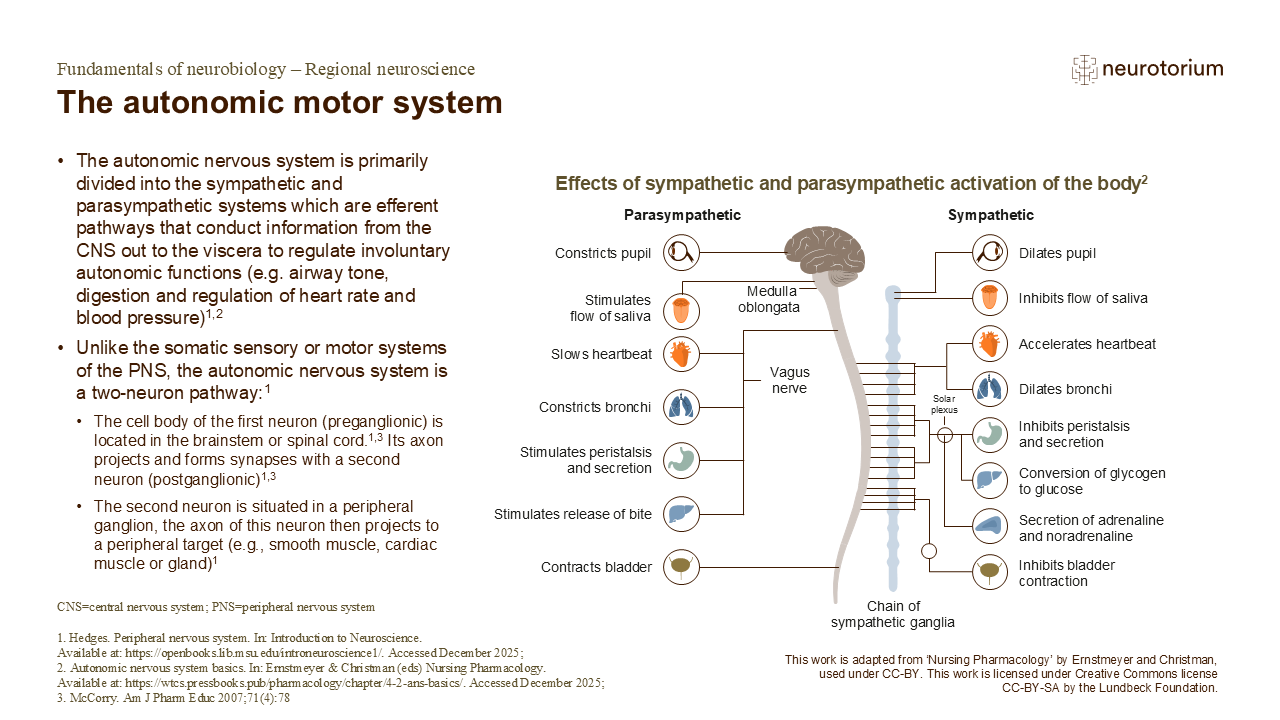
The parasympathetic and sympathetic systems differ with respect to the neurotransmitters used: both use acetylcholine as a transmitter in the preganglionic neurons, but most postganglionic sympathetic neurons use noradrenaline whereas postganglionic parasympathetic neurons use acetylcholine.1 They are also located differently; the sympathetic division includes neurons with ganglia near the spinal cord (shown on the slide), whereas the parasympathetic division includes long presynaptic neurons that connect with postsynaptic neurons in peripheral ganglia located close to the target organ.1
The actions of the sympathetic and parasympathetic system are often antagonistic, but always divergent.1 The sympathetic system mediates the ‘fight or flight’ response (increasing heart rate and airway dilation, decreasing blood flow to viscera (internal organs) and increasing blood flow to muscle).1,2 The parasympathetic system mediates the ‘rest and digest’ response (slowing heart rate, increasing blood flow to digestive organs and increasing gastric motility.1,2 The functions of the sympathetic and parasympathetic systems are summarised in the table on the next slide.
References:
1. Hedges V. Peripheral nervous system. In: Introduction to Neuroscience. Available at: https://openbooks.lib.msu.edu/introneuroscience1/. Accessed December 2025.
2. Autonomic nervous system basics. In: Ernstmeyer K, Christman E (eds) Nursing Pharmacology. Available at: https://wtcs.pressbooks.pub/pharmacology/chapter/4-2-ans-basics/. Accessed December 2025.
3. McCorry LK. Physiology of the autonomic nervous system. Am J Pharm Educ 2007; 71 (4): 78.