

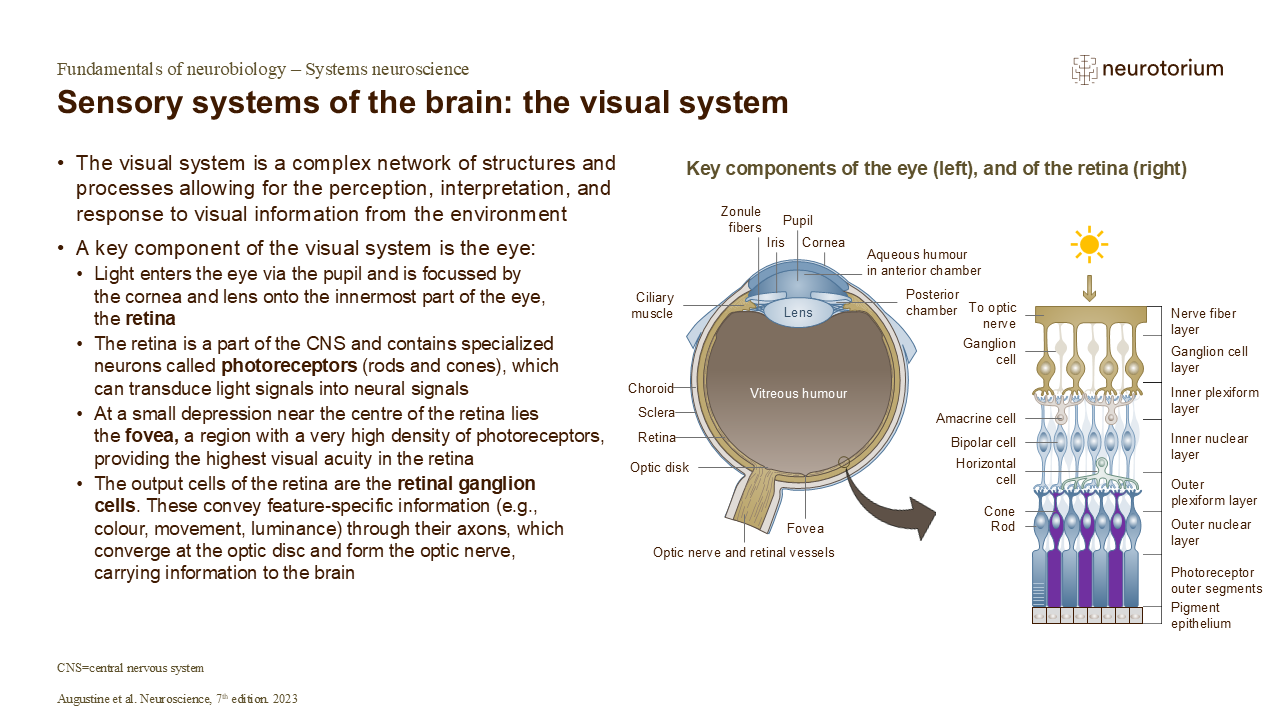
The retina is a thick (few hundred micrometres) sheet of neurons.2 It contains five major cell types, arranged in three cellular layers (i. photoreceptors [rods or cones]; ii. horizontal, bipolar and amacrine cells; iii. ganglion cells), separated by the outer and inner (synaptic) plexiform layers.2 The photoreceptor cells absorb light, convert it into a neural signal through a process called phototransduction, and pass the signal synaptically to bipolar cells, which in turn pass it to retinal ganglion cells in the innermost layer of the retina. The axons of the retinal ganglion cells form the optic nerve.2 The horizontal and amacrine cells provide the lateral connections in the outer and inner synaptic layers.2
The neural circuit in the retina performs low-level visual processing by extracting certain spatial and temporal features and conveying these to the higher visual centres.2
References:
1.Augustine GJ, Groh JM, Huettel SA, et al. Neuroscience, 7th edition. Oxford University Press Academic US; 2023.
2.Kandel ER, Koester JD, Mack SH, Siegelbaum SA. Principles of Neural Science, 6th edition. McGraw-Hill Professional; 2021.