

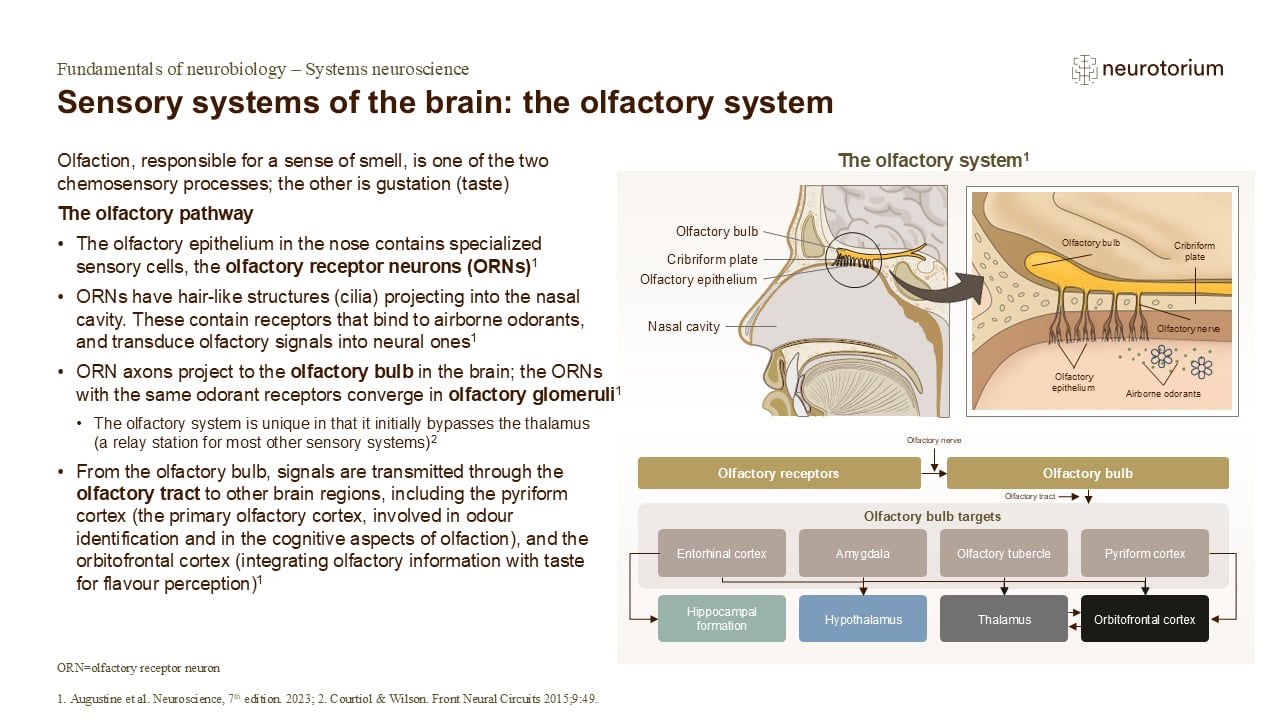
Apart from the main olfactory pathway, many species also have an accessory olfactory pathway for the detection of pheromones: species- and gender-specific chemical cues that provide information about an individual’s social, sexual and reproductive status.3 The sensory structure for pheromone detection in mammals is the vomeronasal organ (VNO).3
Anatomical studies suggest that the VNO exists in adult humans, but it lacks sensory neurons and nerve bundles.3 The likely explanation for this phenomenon is that humans either do not detect pheromones and have developed other strategies for recognizing potential partners or attackers, or that they detect odours acting as pheromones in triggering behaviours involved in reproduction or aggression through the main olfactory pathway.3
References:
1.Augustine GJ, Groh JM, Huettel SA, et al. Neuroscience, 7th edition. Oxford University Press Academic US; 2023.
2.Courtiol E, Wilson DA. The olfactory thalamus: unanswered questions about the role of the mediodorsal thalamic nucleus in olfaction. Front Neural Circuits 2015; 9: 49.
3.Squire LR, Berg D, Bloom FE, et al. Fundamental Neuroscience, 4th edition. Elsevier S&T; 2012.