

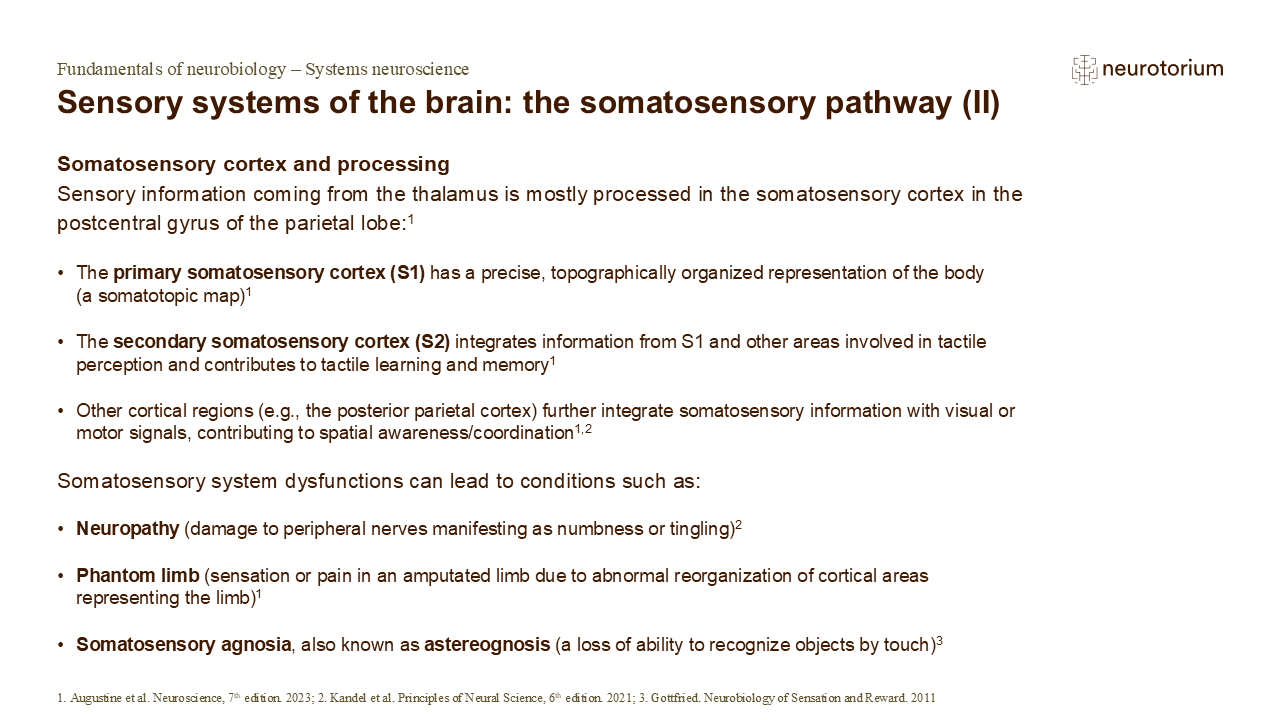
An important source of information about the function of different neural structures, including the posterior parietal cortex, are studies of naturally occurring or experimental lesions, which have demonstrated the crucial role of the parietal cortex in linking sensory information to motor actions.2 The parietal lobe extracts sensory information about the external world and the person’s own body for the planning and guidance of movements.2 Accordingly, people with lesions affecting certain parts of the parietal lobe may for example struggle with directing their arm and hand accurately to the location of objects in space, and with shaping the orientation and grip aperture of their hand before grasping the object in question.2 They may also be unable to make rapid adjustments to their ongoing reach and grasping for the object in response to the object suddenly changing location or orientation.2
It is important to note that effects of lesions to specific regions of the brain should be interpreted with caution, as it may be incorrect to conclude a specific function is directed solely by a single region, or that the region in question only performs that function.2 In addition, the adverse impact of an injury to a specific neural structure can be masked or adjusted by compensatory mechanisms in the remaining, uninjured structures.2
References:
1.Augustine GJ, Groh JM, Huettel SA, et al. Neuroscience, 7th edition. Oxford University Press Academic US; 2023.
2.Kandel ER, Koester JD, Mack SH, Siegelbaum SA. Principles of Neural Science, 6th edition. McGraw-Hill Professional; 2021.
3.Gottfried JA. Neurobiology of sensation and reward. CRC Press / Taylor & Francis; 2011.