

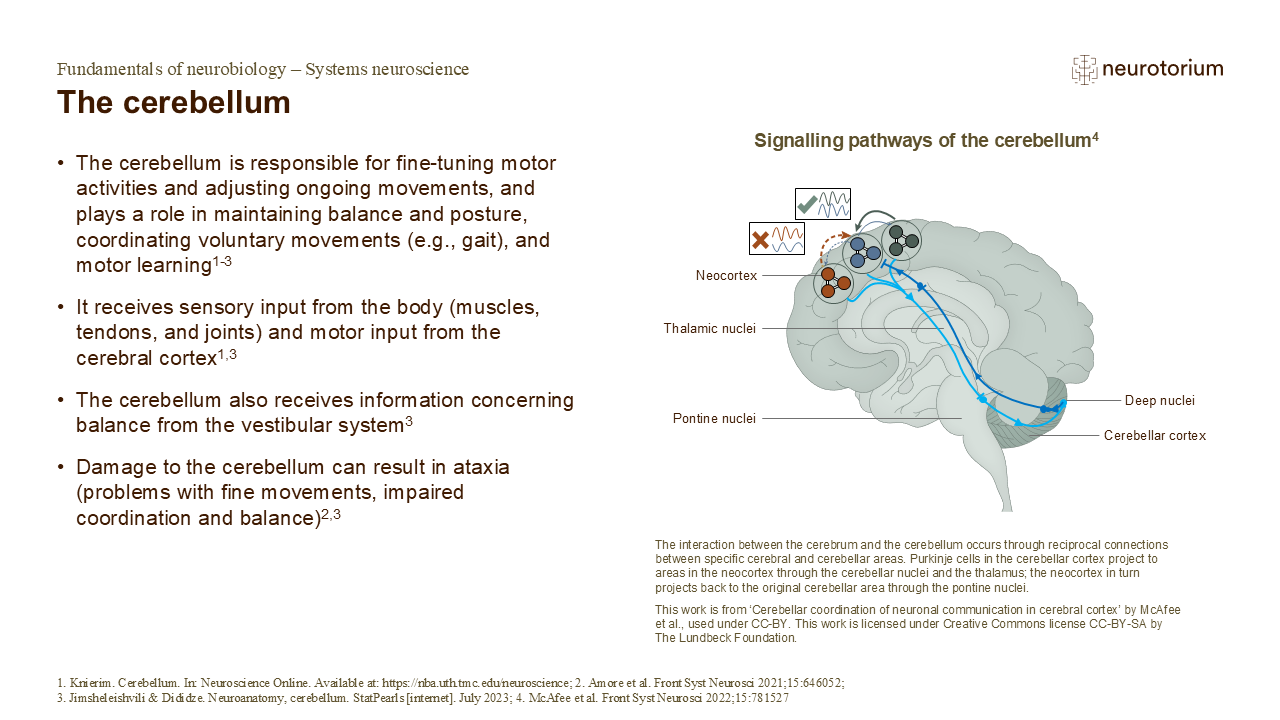
The cerebellum represents only 10% of the total volume of the brain, but contains over 50% of the brain’s neurons.5 The cerebellar cortex is composed of multiple units that are highly repetitive and regular in their structure and contain the same basic microcircuits, with different cerebellar regions receiving projections from distinct brain and spinal structures and then projecting back to the neocortex.5 The uniformity of cerebellar architecture and physiology suggests that different regions of the cerebellum perform similar computational tasks on varying inputs.5
The physiological function of the cerebellum is underpinned by the following key principles:5
1.The cerebellum acts prior to sensory feedback arising from movement, and therefore provides feedforward control of muscular contractions
2.For achieving this control, the cerebellum relies on internal body models to process and compare sensory inputs with copies of motor commands3.The cerebellum is key for motor and perceptual timing, and for adapting and learning motor skills4.The cerebellum of primates is deeply interconnected with non-motor areas of the cerebral cortex, likely performing similar actions in the execution and learning of motor and non-motor behaviours
References:
1.Knierim J. Chapter 5: Cerebellum. In: Neuroscience Online. Available at: https://nba.uth.tmc.edu/neuroscience. Accessed September 2025.
2.Amore G, Spoto G, Ieni A, et al. A focus on the cerebellum: From embryogenesis to an age-related clinical perspective. Front Syst Neurosci 2021 15: 646052.
3.Jimsheleishvili S, Dididze M. Neuroanatomy, cerebellum. StatPearls [internet]. July 2023. Accessed September 2025.
4.McAfee SS, Liu Y, Sillitoe RV, Heck DH. Cerebellar coordination of neuronal communication in cerebral cortex. Front Syst Neurosci 2022; 15: 781527.
5.Kandel ER, Koester JD, Mack SH, Siegelbaum SA. Principles of Neural Science, 6th edition. McGraw-Hill Professional; 2021.