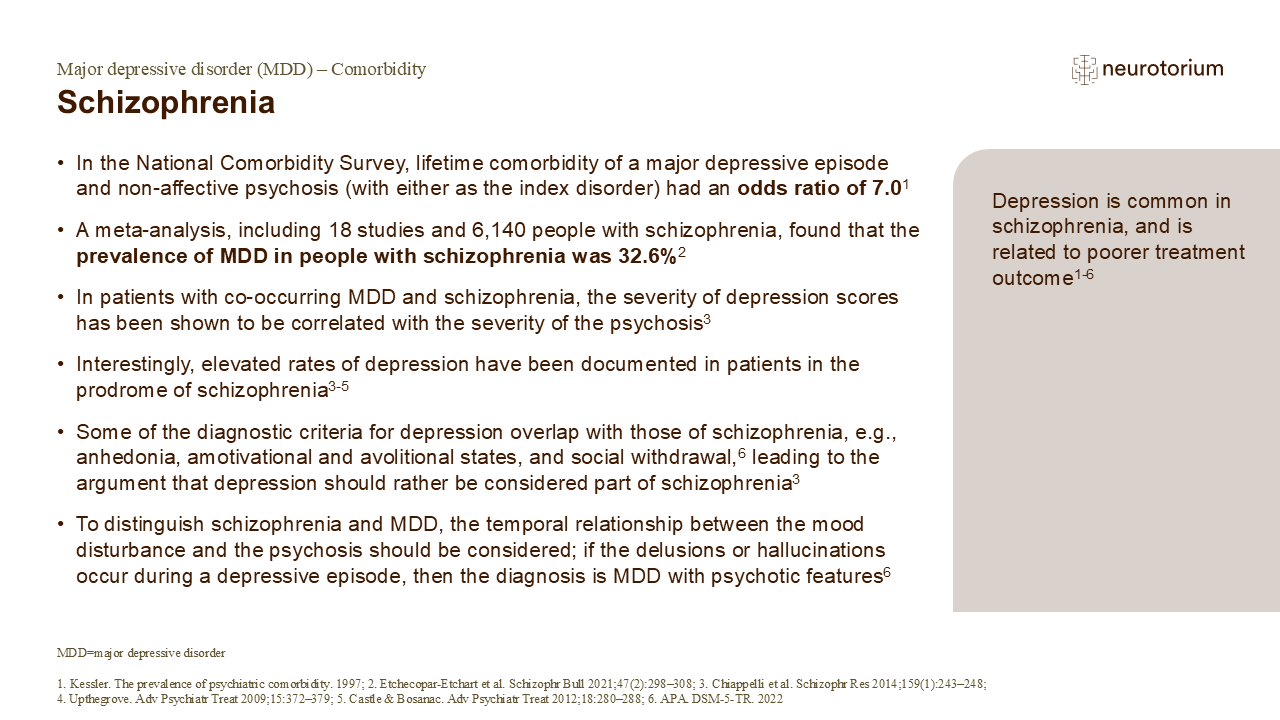
The essential feature of schizophrenia is the presence of hallucinations, delusions, disorganised speech or behaviour, or of negative symptoms.6 As noted on the slide, some of the diagnostic criteria for schizophrenia overlap with those for MDD, particularly MDD with psychotic or catatonic features.6 To distinguish the two, the temporal relationship between the mood disturbance and the psychosis should be considered; if the delusions or hallucinations occur exclusively during a depressive episode, then the diagnosis is MDD with psychotic features (or bipolar with psychotic features, if that diagnosis more accurately reflects the symptoms).6
References:
1.Kessler RC. The prevalence of psychiatric comorbidity. In: Wetzler S, Sanderson WC (eds). An Einstein Psychiatry Publication, No. 14. Treatment Strategies for Patients with Psychiatric Comorbidity. John Wiley & Sons Inc. 1997.
2.Etchecopar-Etchart D, Korchia T, Loundou A, et al. Comorbid major depressive disorder in schizophrenia: a systematic review and meta-analysis. Schizophr Bull 2021; 47 (2): 298–308.
3.Chiappelli J, Kochunov P, DeRiso K, et al. Testing trait depression as a potential clinical domain in schizophrenia. Schizophr Res 2014; 159 (1): 243–248.
4.Upthegrove R. Depression in schizophrenia and early psychosis: implications for assessment and treatment. Adv Psychiatr Treat 2009; 15: 372–379.
5.Castle D, Bosanac P. Depression and schizophrenia. Adv Psychiatr Treat 2012; 18: 280–288.
6.American Psychiatric Association. Diagnostic and Statistical Manual of Mental Disorders. Fifth Edition – text revision. © American Psychiatric Association, 2022.