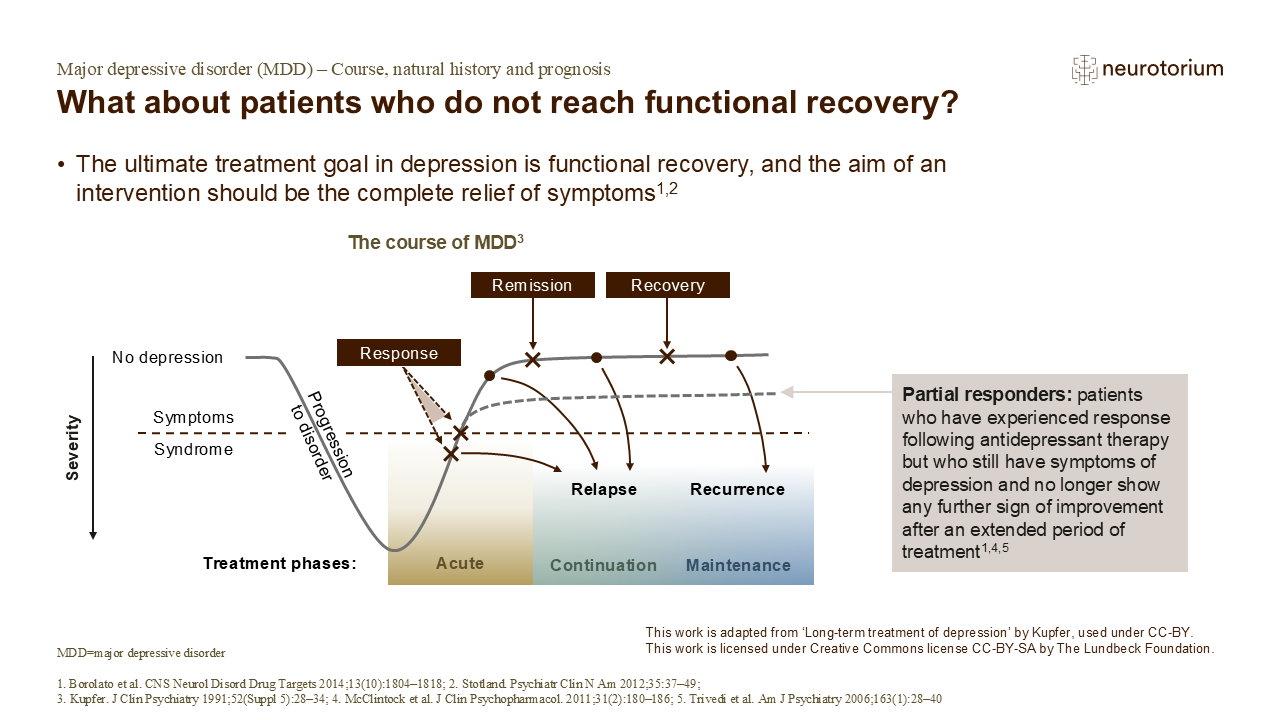
The ultimate treatment goal in depression is functional recovery, and the aim of an intervention should be the complete relief of symptoms,1,2 associated with;
- improved functioning6
- better overall quality of life6
- lower likelihood of relapse.7
References:
1.Bortolato B, Carvalho AF, McIntyre RS. Cognitive dysfunction in major depressive disorder: a state-of-the-art clinical review. CNS Neurol Disord Drug Targets 2014; 13 (10): 1804–1818.
2.Stotland. Recovery from depression. Psychiatr Clin N Am 2012; 35: 37–49.
3.Kupfer DJ. Long-term treatment of depression. J Clin Psych 1991; 52 (Suppl 5): 28–34.
4.McClintock SM, Husain MM, Wisniewski SR, et al. Residual symptoms in depressed outpatients who respond by 50% but do not remit to antidepressant medication. J Clin Psychopharmacol 2011; 31 (2): 180–186.
5.Trivedi MH, Rush AJ, Wisniewski SR, et al. Evaluation of outcomes with citalopram for depression using measurement-based care in STAR*D: implications for clinical practice. Am J Psychiatry 2006; 163 (1): 28–40.
6.Greer TL, Kurian BT, Trivedi MH. Defining and measuring functional recovery from depression. CNS Drugs 2010; 24 (4): 267–284.
7.Tranter R, O’Donovan C, Chandarana P, Kennedy S. Prevalence and outcome of partial remission in depression. J Psychiatry Neurosci 2002; 27 (4): 241–247.