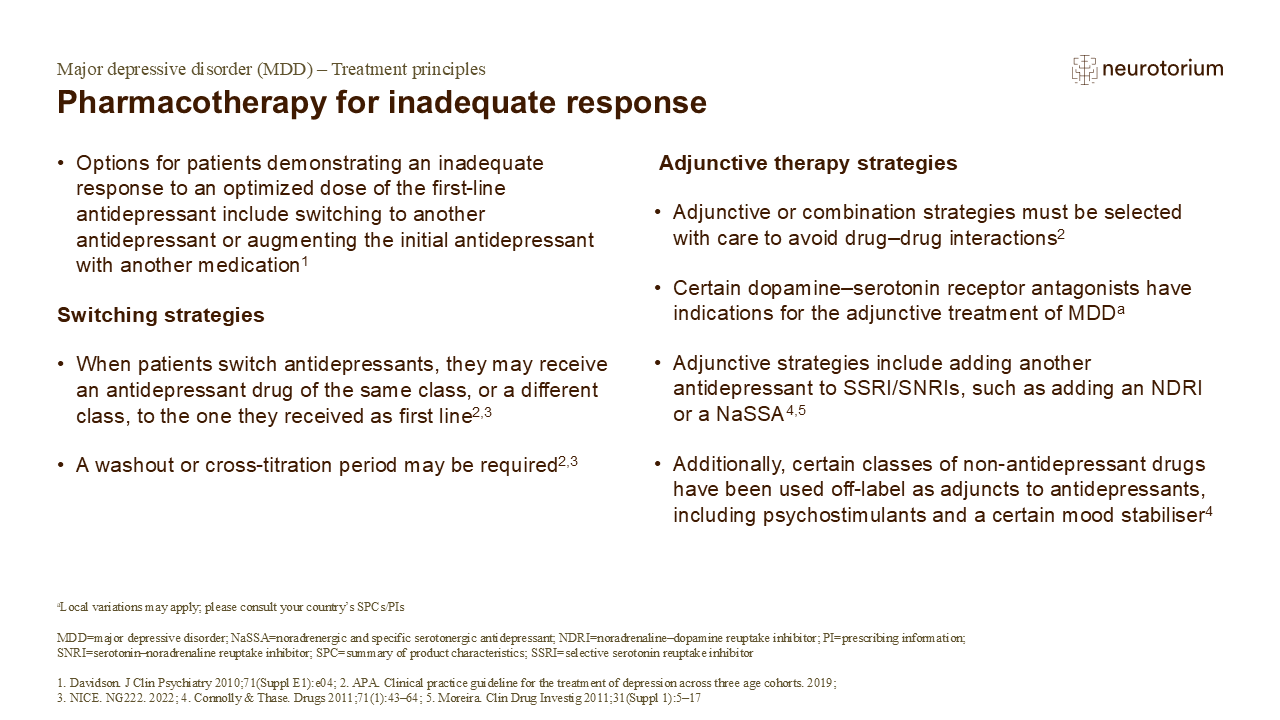
Second-line options include switching to another antidepressant, augmenting the initial antidepressant with a non-antidepressant drug, or combining it with another antidepressant.1 In clinical practice, although there is no evidence to support it, switching is generally used in cases of non-response to antidepressant monotherapy, whereas adjunctive and combination strategies are generally used to build upon a partial symptomatic response to antidepressant monotherapy.1
References:
1.Davidson JR. Major depressive disorder treatment guidelines in America and Europe. J Clin Psychiatry 2010; 71 (Suppl E1): e04.
2.American Psychological Association. Clinical practice guideline for the treatment of depression across three age cohorts. © American Psychological Association, 2019. https://www.apa.org/depression-guideline/guideline.pdf. Accessed April 2025.
3.National Institute for Health and Care Excellence. Depression in adults: treatment and management. Guideline 222, June 2022. © NICE, June 2022, updated September 2024. https://www.nice.org.uk/guidance/ng222. Accessed April 2025.
4.Connolly KR, Thase ME. If at first you don’t succeed: a review of the evidence for antidepressant augmentation, combination and switching strategies. Drugs 2011; 71 (1): 43–64.
5.Moreira R. The efficacy and tolerability of bupropion in the treatment of major depressive disorder. Clin Drug Investig 2011; 31 (Suppl 1): 5–17.