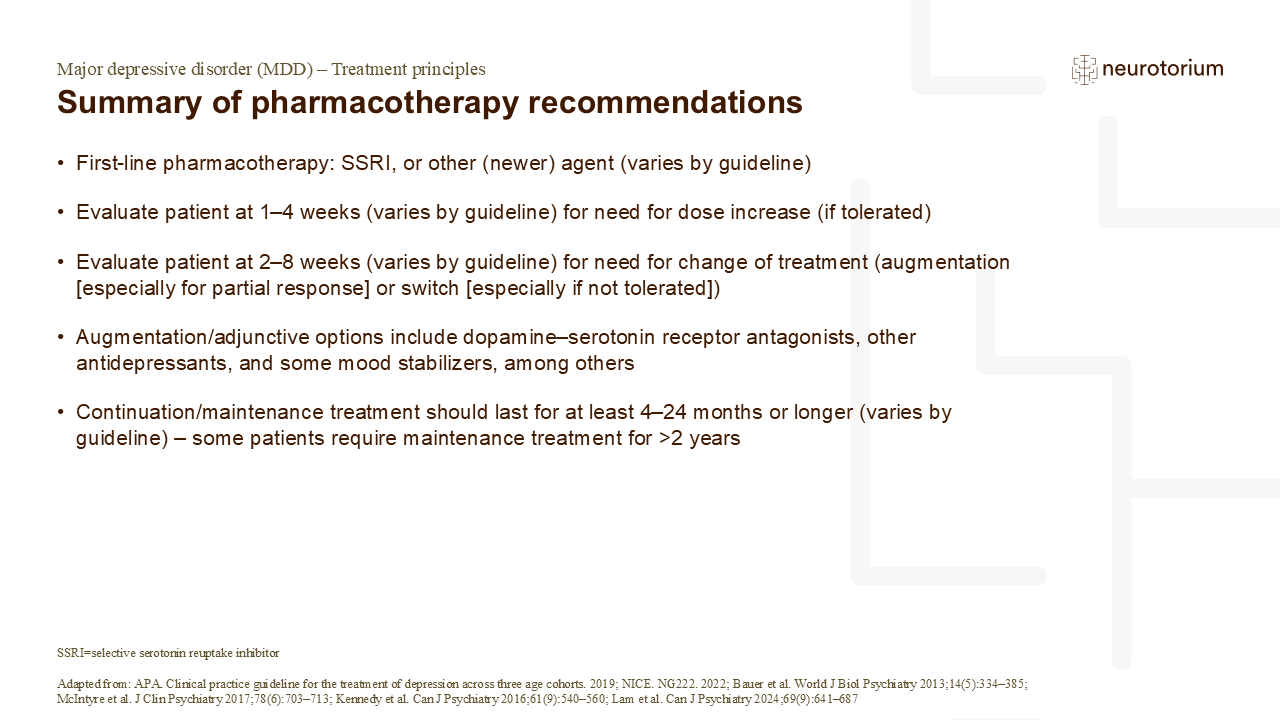
A summary of the guidelines for the treatment of MDD are shown on the slide. As already discussed, guidelines generally recommend treatment with an SSRI, close supervision, followed by maintenance therapy.1-6
References:
1.American Psychological Association. Clinical practice guideline for the treatment of depression across three age cohorts. © American Psychological Association, 2019. https://www.apa.org/depression-guideline/guideline.pdf. Accessed April 2025.
2.National Institute for Health and Care Excellence. Depression in adults: treatment and management. Guideline 222, June 2022. © NICE, June 2022, updated September 2024. https://www.nice.org.uk/guidance/ng222. Accessed April 2025.
3.Bauer M, Pfennig A, Severus E, et al.; World Federation of Societies of Biological Psychiatry (WFSBP) Task Force on Unipolar Depressive Disorders. WFSBP guidelines for biological treatment of unipolar depressive disorders, part 1: update 2013 on the acute and continuation treatment of unipolar depressive disorders. World J Biol Psychiatry 2013; 14 (5): 334–385.
4.McIntyre RS, Suppes T, Tandon R, Ostacher M. Florida best practice psychotherapeutic medication guidelines for adults with major depressive disorder. J Clin Psychiatry 2017; 78 (6): 703–713.
5.Kennedy SH, Lam RW, McIntyre RS, et al. Canadian Network for Mood and Anxiety Treatments (CANMAT) 2016 clinical guidelines for the management of adults with major depressive disorder: section 3. Pharmacological treatments. Can J Psychiatry 2016; 61 (9): 540–560.
6.Lam RW, Kennedy SH, Adams C, et al. Canadian Network for Mood and Anxiety Treatments (CANMAT) 2023 update on clinical guidelines for management of major depressive disorder in adults: Réseau canadien pour les traitements de l’humeur et de l’anxiété (CANMAT) 2023: mise à jour des lignes directrices cliniques pour la prise en charge du trouble dépressif majeur chez les adultes. Can J Psychiatry 2024; 69 (9): 641–687.