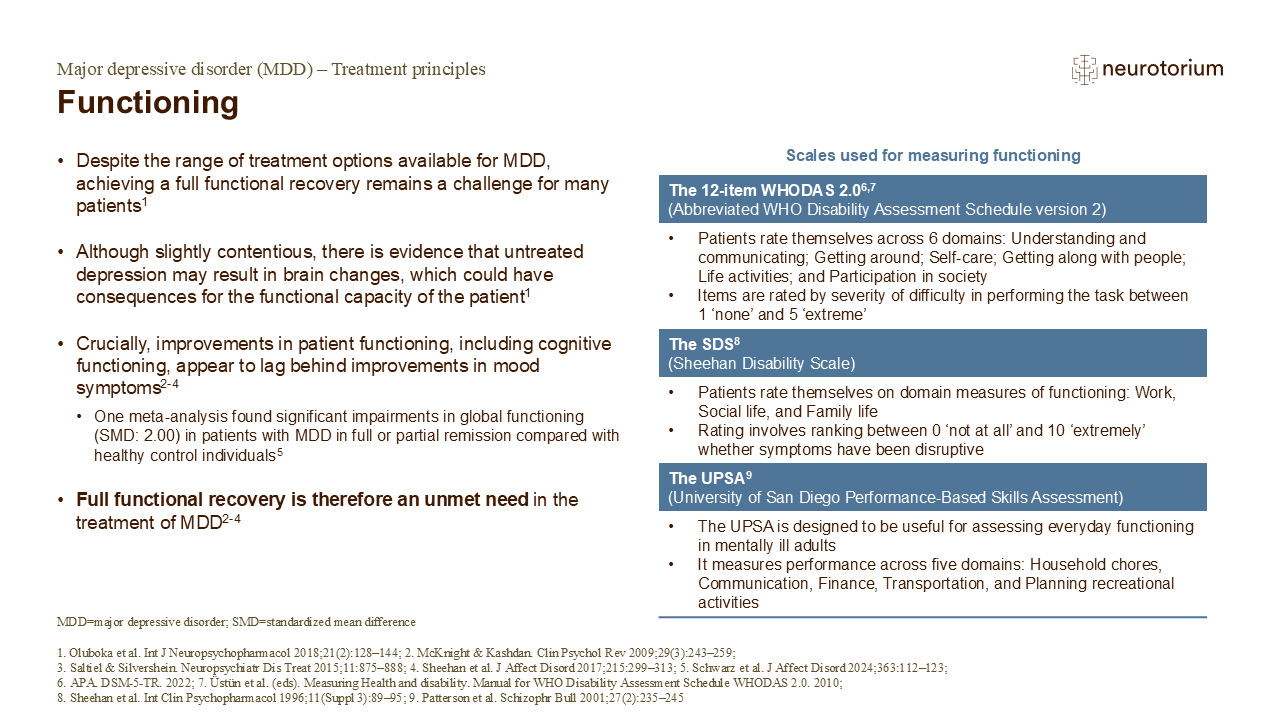
Achieving full functional recovery in patients with MDD is challenging, partly because patient functioning may be less responsive to treatment than mood symptoms.2,3
Recommendations were published in 2017, based on a consensus of expert opinion, which underscore the importance of treating MDD early, and successfully, in order to preserve the neurocognitive function of the patient and restore them to full functioning.1 Among the considerations in these recommendations are: factors to consider when selecting an antidepressant; how to assess the progress of treatment; obstacles to treatment adherence; and what affect comorbidities have on the long-term treatment plan.1 It is hoped that by using a patient-centred approach throughout treatment of MDD, the treatment plan will be aligned with the patients’ individual characteristics and needs, and their own goals for recovery.1
References:
1.Oluboka OJ, Katzman MA, Habert J, et al. Functional recovery in major depressive disorder: providing early optimal treatment for the individual patient. Int J Neuropsychopharmacol 2018; 21 (2): 128–144.
2.McKnight PE, Kashdan TB. The importance of functional impairment to mental health outcomes: a case for reassessing our goals in depression treatment research. Clin Psychol Rev 2009; 29 (3): 243–259.
3.Saltiel PF, Silvershein DI. Major depressive disorder: mechanism-based prescribing for personalized medicine. Neuropsychiatr Dis Treat 2015; 11: 875–888.
4.Sheehan DV, Nakagome K, Asami Y, et al. Restoring function in major depressive disorder: a systematic review. J Affect Disord 2017; 215: 299–313.
5.Schwarz R, Munkholm K, Christensen MS, et al. Functioning in patients with major depressive disorder in remission: a systematic review and meta-analysis. J Affect Disord 2024; 363: 112–123.
6.American Psychiatric Association. Diagnostic and Statistical Manual of Mental Disorders. 5th Edition – Text Revision (DSM-5-TR). © American Psychiatric Association, 2022.
7.Üstün TB, Kostanjsek N, Chatterji S, Rehm J (eds). Measuring Health and disability. Manual for WHO Disability Assessment Schedule WHODAS 2.0. World Health Organization, 2010.
8.Sheehan DV, Harnett-Sheehan K, Raj BA. The measurement of disability. Int Clin Psychopharmacol 1996; 11 (Suppl 3): 89–95.
9.Patterson TL, Goldman S, McKibbin CL, et al. UCSD Performance-Based Skills Assessment: development of a new measure of everyday functioning for severely mentally ill adults. Schizophr Bull 2001; 27 (2): 235–245.