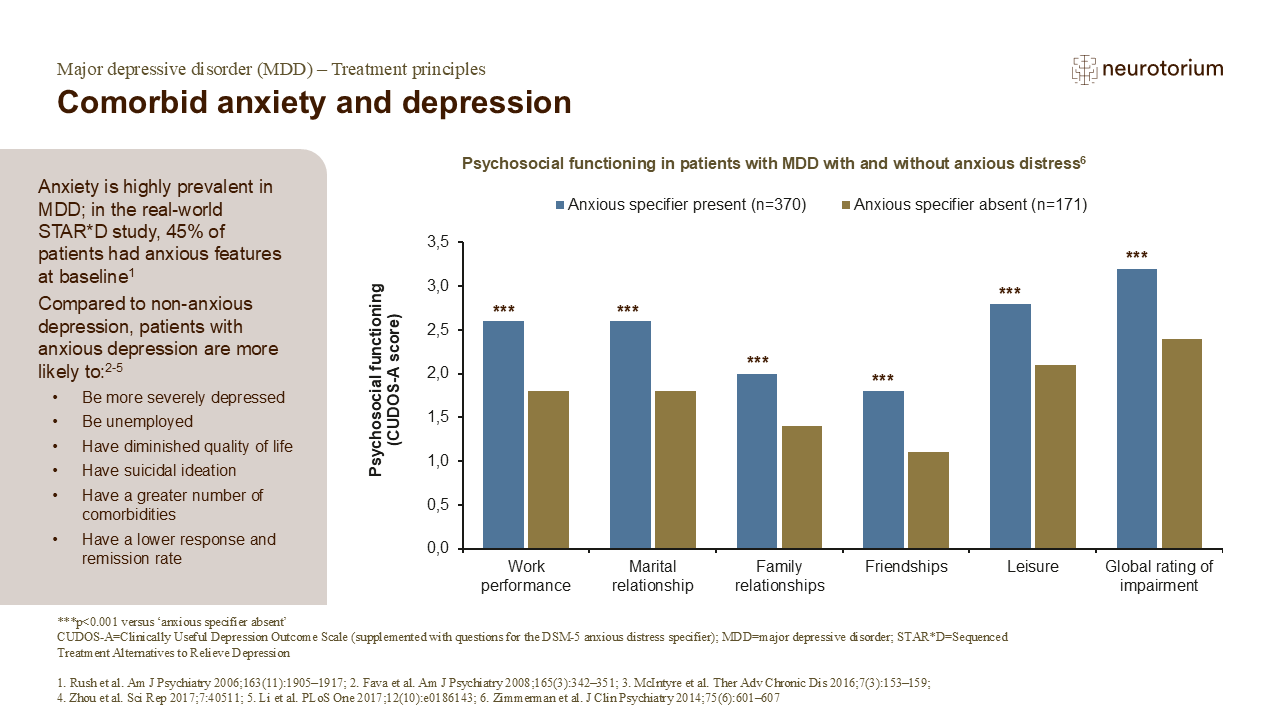
Anxiety is also highly prevalent in MDD; in the real-world STAR*D study, 45% of patients had anxious features at baseline.1,2 In a German inpatient setting, 49% of patients had anxious depression, defined as high levels of anxiety symptoms.7 In the German inpatient setting, patients with high levels of anxiety were more likely to report greater illness severity and a longer episode duration.7 In a survey of prescribing patterns in 411 physicians based in the US or Europe, 295 (71.8%) indicated that they preferred to reserve antipsychotics for patients with MDD who had specific symptoms.8 Anxious mood and irritability were listed more often by physicians who actually prescribed an adjunctive antipsychotic during the survey than those who did not.8
There is an unmet need in the treatment of MDD for adjunctive strategies to help treat patients who experience depression with anxiety.1-8
References:
1.Rush AJ, Trivedi MH, Wisniewski SR, et al. Acute and longer-term outcomes in depressed outpatients requiring one or several treatment steps: a STAR*D report. Am J Psychiatry 2006; 163 (11): 1905–1917.
2.Fava M, Rush AJ, Alpert JE, et al. Difference in treatment outcome in outpatients with anxious versus nonanxious depression: a STAR*D report. Am J Psychiatry 2008; 165 (3): 342–351.
3.McIntyre RS, Woldeyohannes HO, Soczynska JK, et al. The prevalence and clinical characteristics associated with Diagnostic and Statistical Manual Version-5-defined anxious distress specifier in adults with major depressive disorder: results from the International Mood Disorders Collaborative Project. Ther Adv Chronic Dis 2016; 7 (3): 153–159.
4.Zhou Y, Cao Z, Yang M, et al. Comorbid generalized anxiety disorder and its association with quality of life in patients with major depressive disorder. Sci Rep 2017; 7: 40511.
5.Li H, Luo X, Ke X, et al. Major depressive disorder and suicide risk among adult outpatients at several general hospitals in a Chinese Han population. PLoS One 2017; 12 (10): e0186143.
6.Zimmerman M, Chelminski I, Young D, et al. A clinically useful self-report measure of the DSM-5 anxious distress specifier for major depressive disorder. J Clin Psychiatry 2014; 75 (6): 601–607.
7.Wiethoff K, Bauer M, Baghai TC, et al. Prevalence and treatment outcome in anxious versus nonanxious depression: results from the German Algorithm Project. J Clin Psychiatry 2010; 71 (8): 1047–1054.
8.McIntyre RS, Weiller E. Real-world determinants of adjunctive antipsychotic prescribing for patients with major depressive disorder and inadequate response to antidepressants: a case review study. Adv Ther 2015; 32 (5): 429–444.