

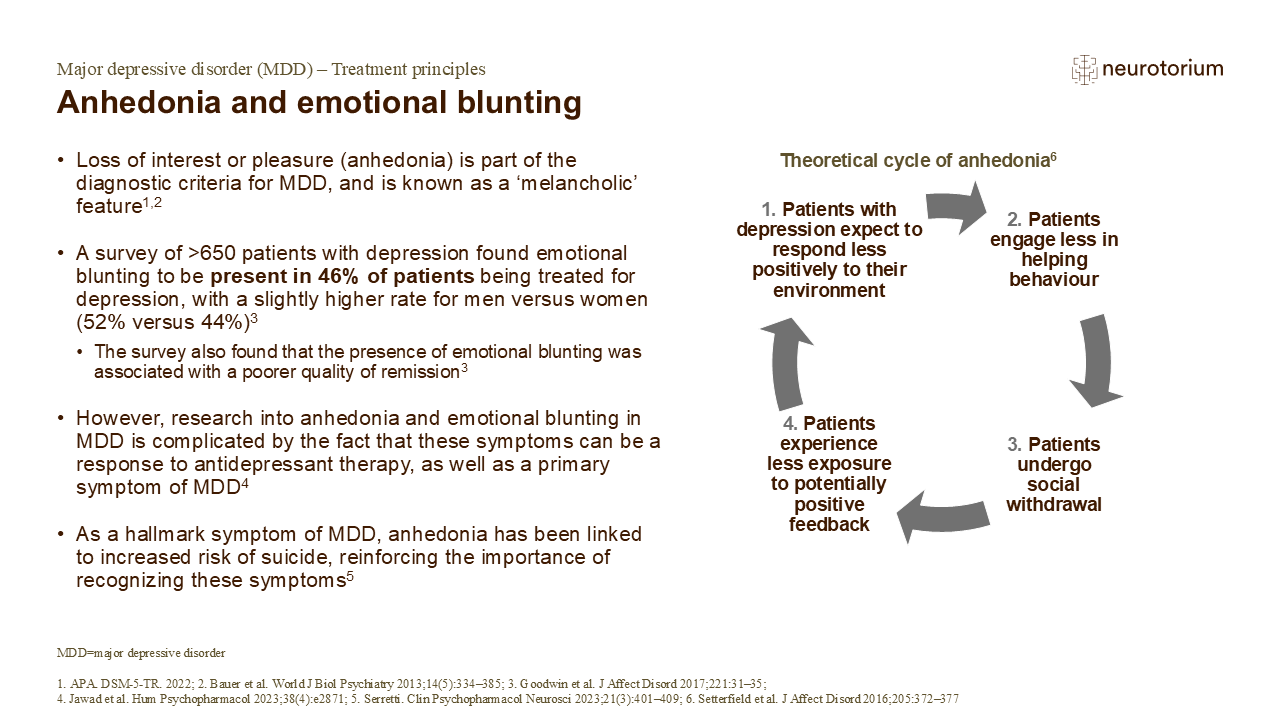
Emotional blunting appears to be present in almost half of patients with depression taking antidepressants.3 One hypothesis of the cycle of anhedonia in patients with depression is shown on the slide; this hypothesis comes from a series of experiments performed on a sample of psychology students.6 The students were given the Beck Depression Inventory (BDI), and only those who displayed either high (BDI score >20) or low (<10) depressive symptomatology were included in the study.6 As well as completing a series of questionnaires, their helping behaviour was tested during the debriefing process when, in what was made to seem like an accident, a researcher dropped a pile of papers near the participant – latency to help, and the degree of help provided was used as a proxy for helping behaviour, and social anhedonia.6 Higher levels of participants not helping were seen in the high depressive symptomatology group.6
There have been attempts to assay the effectiveness of newer antidepressants against the symptoms of anhedonia; one such study found that treatment over eight weeks with a melatonin receptor agonist decreased severity scores on depression scales, as well as scores on the Snaith-Hamilton Pleasure Scale that measures anhedonia.7 However, effectiveness on symptoms of anhedonia remains an unmet need in the treatment of MDD.3,6,7
References:
5.Serretti A. Anhedonia and depressive disorders. Clin Psychopharmacol Neurosci 2023; 21 (3): 401–409.