

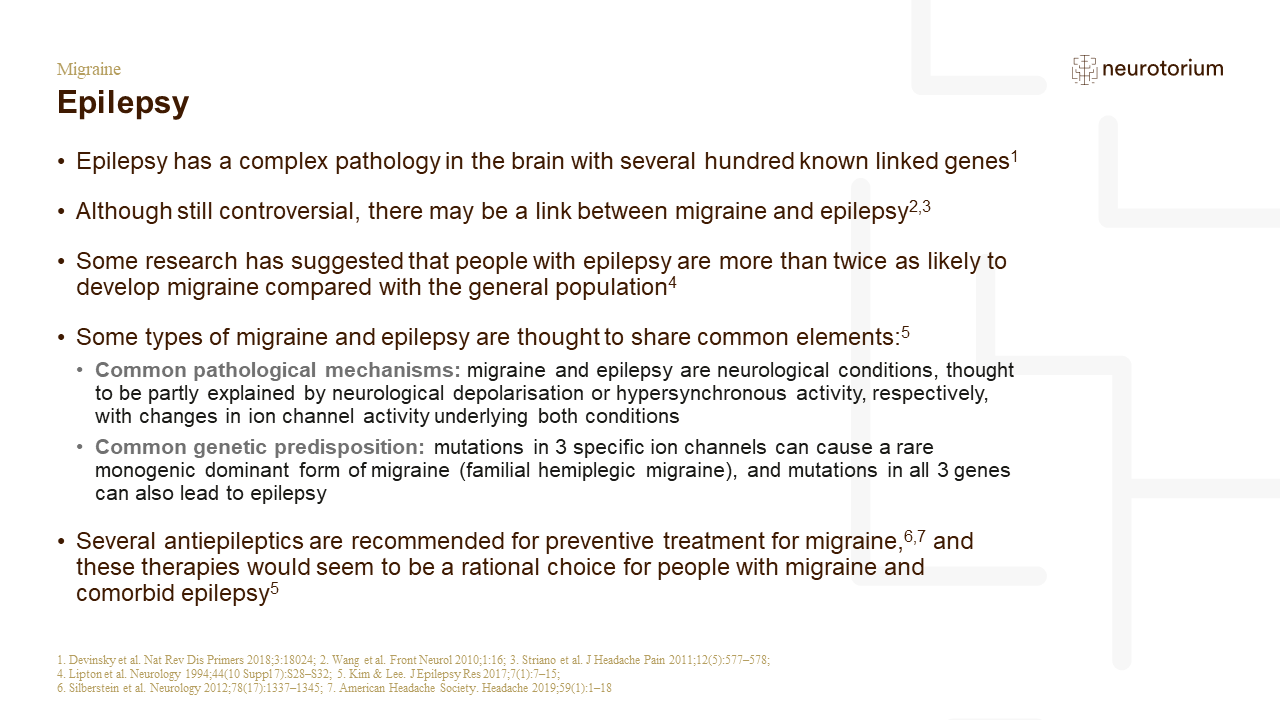
More broadly than migraine, a Lithuanian study analysed a sample of people with epilepsy and found that 83.2% reported some form of headache.[Mameniškienė et al., 2016] The most common type of headache in the sample was tension-type headache (30%), followed by migraine (25%).[Mameniškienė et al., 2016] Although the prevalence of individual types of headaches were not so different from population estimates from the Eurolight study,[Steiner et al., 2014] migraine appeared to be more common in males with epilepsy than the general population.[Mameniškienė et al., 2016]
Other references used on slide:
American Headache Society. The American Headache Society position statement on integrating new migraine treatments into clinical practice. Headache 2019; 59 (1): 1–18.
Devinsky O, Vezzani A, O’Brien TJ, et al. Epilepsy. Nat Rev Dis Primers 2018; 3: 18024.
Kim DW, Lee SK. Headache and epilepsy. J Epilepsy Res 2017; 7 (1): 7–15.
Wang SJ, Chen PK, Fuh JL. Comorbidities of migraine. Front Neurol 2010; 1: 16.