

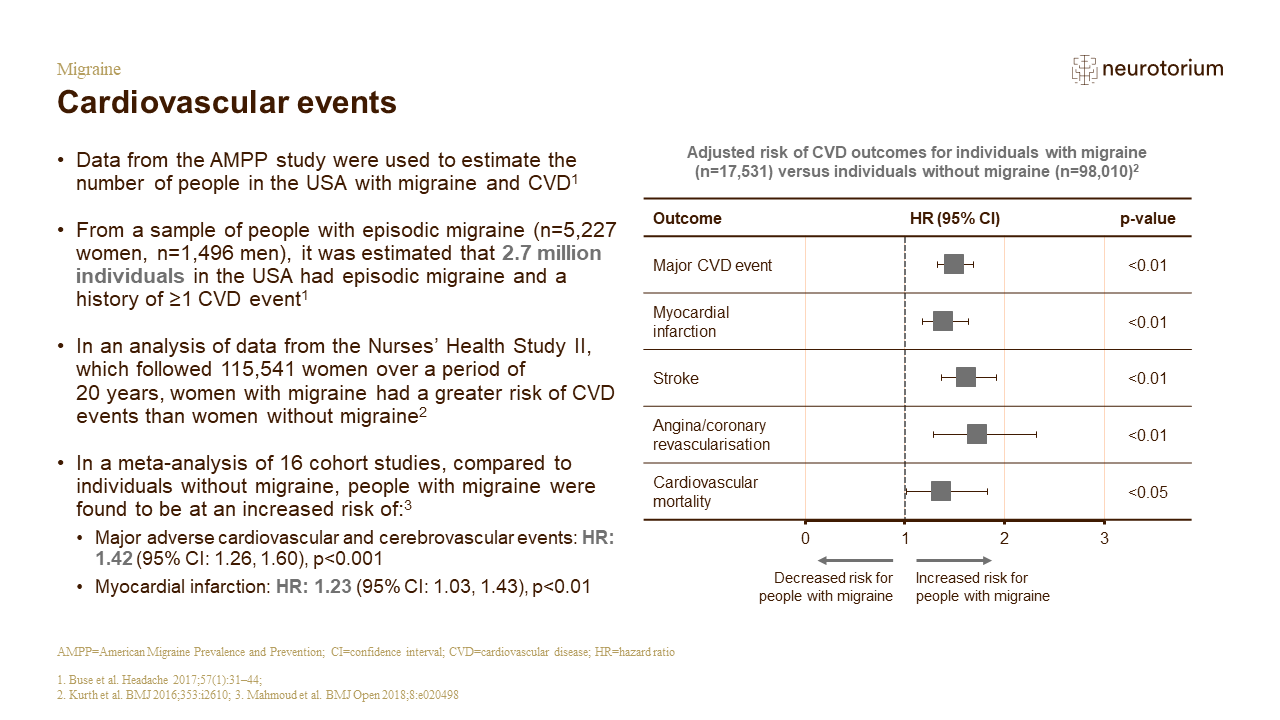
In addition to an association with cardiovascular events, an association of migraine with structural anomalies of the cardiovasculature and cerebrovasculature has also been studied, including:[Schwedt, 2009]
- patent foramen ovale
- atrial septal defects
- pulmonary arteriovenous malformations
- mitral valve prolapse
- atrial septal aneurysm.
With varying degrees of evidential support, migraine is associated with a variety of ‘right-to-left shunts’ (abnormal communication between the right and left sides of the heart or circulatory system, allowing blood to flow directly from one to the other) and cardiac anomalies.[Schwedt, 2009] More research is needed to fully understand the mechanism underlying the association of these anomalies with migraine.[Schwedt, 2009]
Other references used on slide:
Buse DC, Reed ML, Fanning KM, et al. Cardiovascular events, conditions, and procedures among people with episodic migraine in the US population: results from the American Migraine Prevalence and Prevention (AMPP) study. Headache 2017; 57 (1): 31–44.