

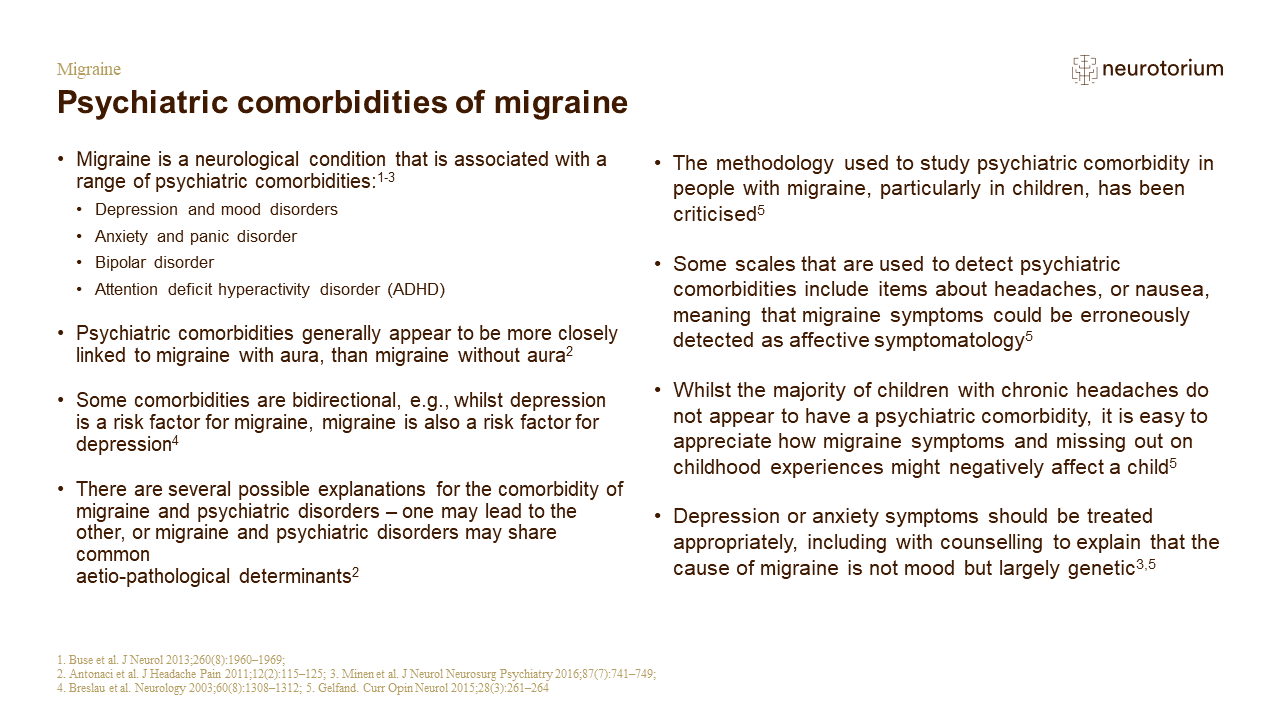
Determining the relationship between migraine and a comorbid condition is complicated; one cohort study aimed to examine the relationship by interviewing people with migraine (n=496), people with headaches (n=151), and people without migraine (n=539) – and then re-interviewing two years later.[Breslau et al., 2003] The results of the cohort study suggested that the presence of migraine at baseline predicted the occurrence of depression at the follow-up interview (odds ratio: 5.8), whereas the presence of headaches at baseline did not.[Breslau et al., 2003] Conversely, the presence of depression at baseline predicted the onset of migraine at the follow-up interview (odds ratio: 3.4), but not other severe headaches.[Breslau et al., 2003] In other words, migraine and depression share a bidirectional relationship.[Breslau et al., 2003]
Other references used on slide:
Antonaci F, Nappi G, Galli F, et al. Migraine and psychiatric comorbidity: a review of clinical findings. J Headache Pain 2011; 12 (2): 115–125.