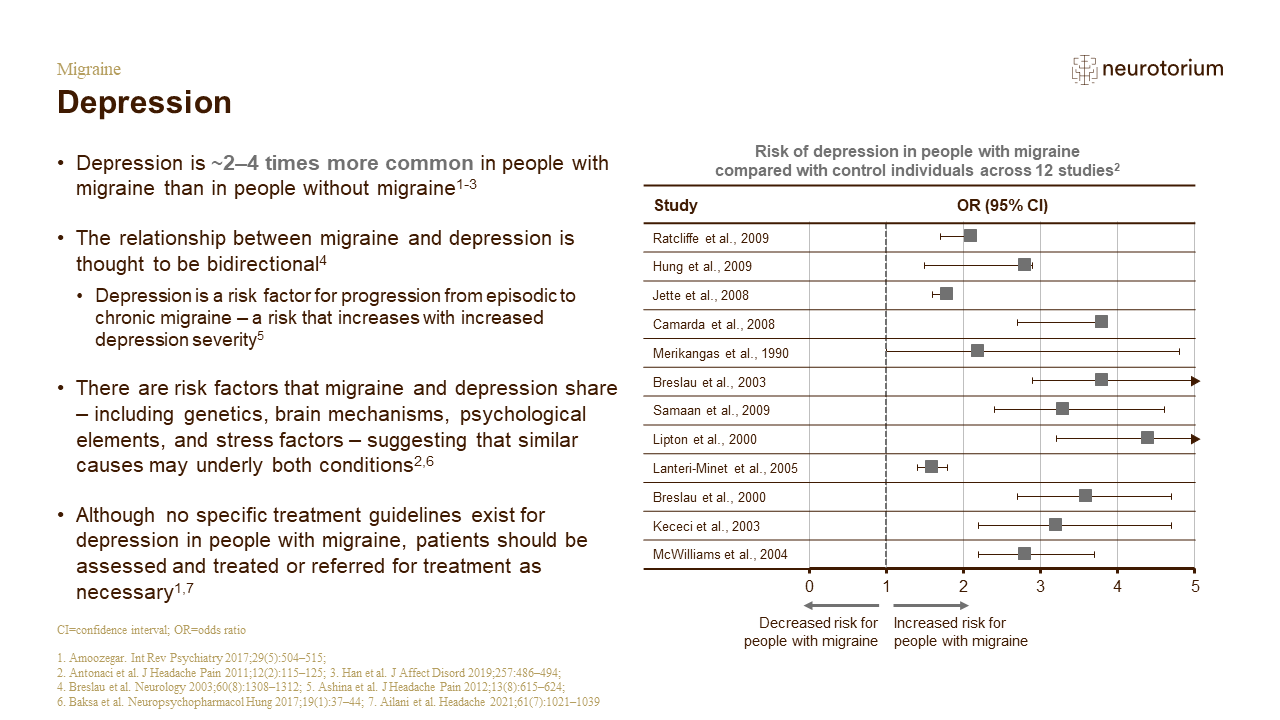
Depression is common among people with migraine – roughly 2–4 times more common than in the general population.[Amoozegar, 2017; Antonaci et al., 2011; Han et al., 2019] The comorbidity of depression and migraine increases the burden of migraine on patients and society.[Antonaci et al., 2011] Data from the Canadian Community Health Survey suggests that migraine with depression is associated with poorer health outcomes than migraine alone.[Jette et al., 2008; Antonaci et al., 2011]
References:
Amoozegar F. Depression comorbidity in migraine. Int Rev Psychiatry 2017; 29 (5): 504–515.
Antonaci F, Nappi G, Galli F, et al. Migraine and psychiatric comorbidity: a review of clinical findings. J Headache Pain 2011; 12 (2): 115–125.
Han KM, Kim MS, Kim A, et al. Chronic medical conditions and metabolic syndrome as risk factors for incidence of major depressive disorder: a longitudinal study based on 4.7 million adults in South Korea. J Affect Disord 2019; 257: 486–494.
Jette N, Patten S, Williams J, et al. Comorbidity of migraine and psychiatric disorders – a national population-based study. Headache 2008; 48 (4): 501–516.
Other references used on slide:
Ailani J, Burch RC, Robbins MS; Board of Directors of the American Headache Society. The American Headache Society consensus statement: update on integrating new migraine treatments into clinical practice. Headache 2021; 61 (7): 1021–1039.
Ashina S, Serrano D, Lipton RB, et al. Depression and risk of transformation of episodic to chronic migraine. J Headache Pain 2012; 13 (8): 615–624.
Baksa D, Gonda X, Juhasz G. Why are migraineurs more depressed? A review of the factors contributing to the comorbidity of migraine and depression. Neuropsychopharmacol Hung 2017; 19 (1): 37–44.
Breslau N, Lipton RB, Stewart WF, et al. Comorbidity of migraine and depression: investigating potential etiology and prognosis. Neurology 2003; 60 (8): 1308–1312.