

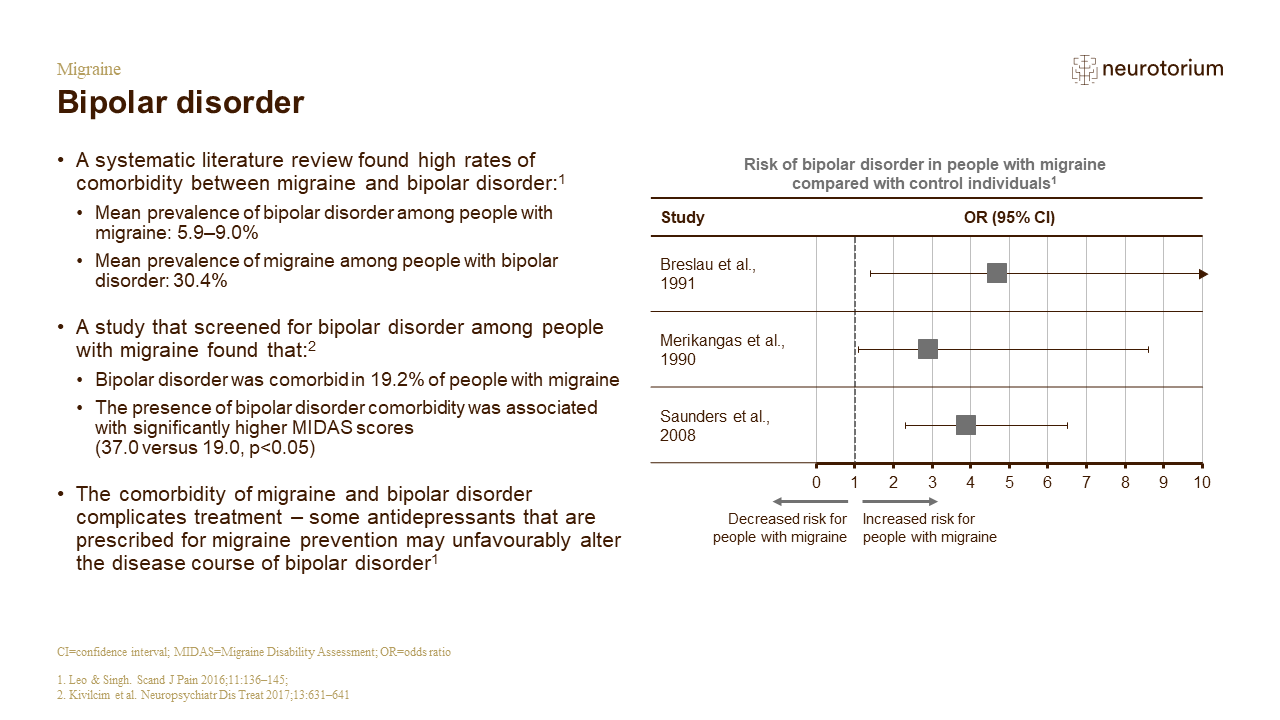
As shown on the slide, the risk of bipolar disorder appears to be greater among people with migraine than the general population.[Leo & Singh, 2016] There also appears to be an increased risk of bipolar disorder in people with migraine with aura than for those with migraine without aura (odds ratio of 7.3 versus 2.4).[Leo & Singh, 2016; Breslau et al., 1991]
The comorbidity of migraine and bipolar disorder increases the burden that migraine places on the patient; data from the Canadian Community Health Survey suggest that migraine with bipolar disorder is associated with poorer health outcomes than migraine alone.[Jette et al., 2008]
Other reference used on slide:
Kivilcim Y, Altintas M, Domac FM, et al. Screening for bipolar disorder among migraineurs: the impact of migraine–bipolar disorder comorbidity on disease characteristics. Neuropsychiatr Dis Treat 2017; 13: 631–641.