

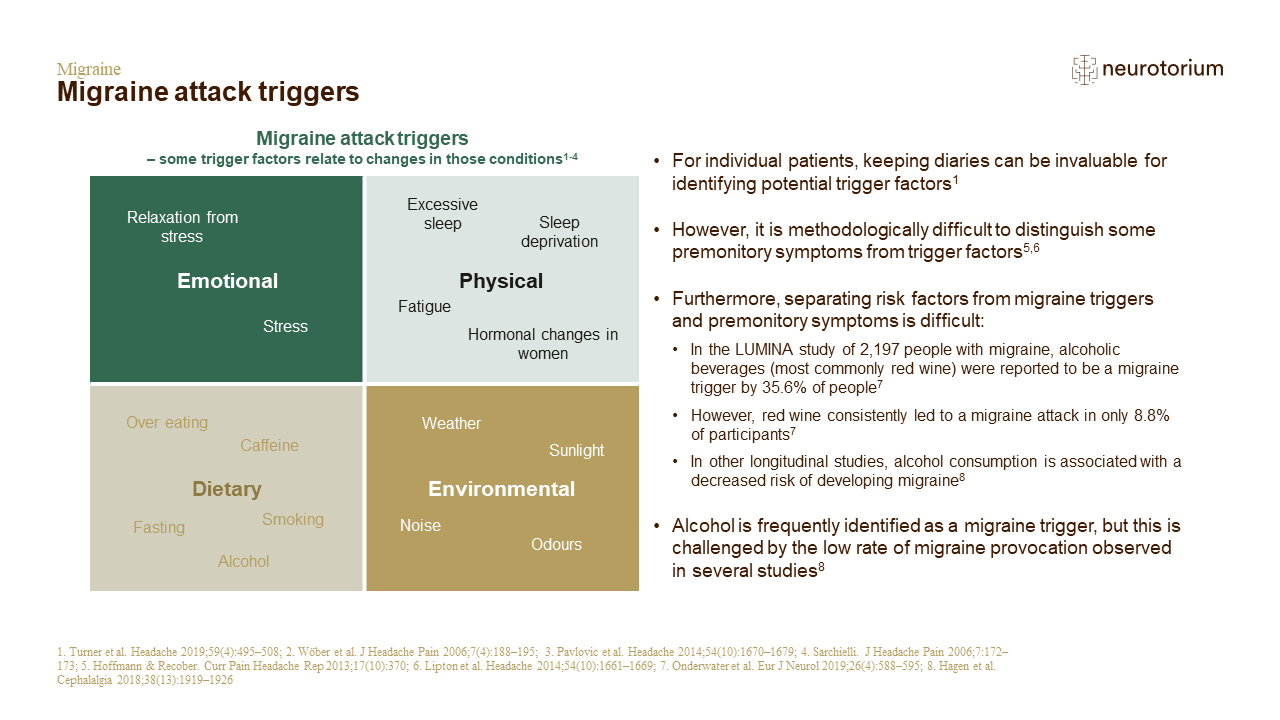
Various different migraine triggers have been identified, including emotional, physical, dietary, and environmental factors.[Migraine Trust; Pavlovic et al., 2014; Park et al., 2016; Sarchielli, 2006; Turner et al., 2019; Wöber et al., 2006] Migraine triggers are a complex set of seemingly conflicting factors, e.g., both lack of sleep, and too much sleep, are linked to triggering migraine.[Migraine Trust] Some have suggested that the amount of change in the exposure to a trigger is crucial for its effect. [Turner et al., 2019] Designing studies to investigate migraine triggers is methodologically challenging; a putative migraine trigger may only act as a trigger in concert with some other factor, (e.g., alcohol might act as a trigger only when the individual is tired), and determining the dosing of the trigger is difficult – how much is a ‘normal’ dose of chocolate?[Pavlovic et al., 2014] However, if a person identifies factors that they believe triggers their migraine attacks, this opens up the possibility of pre-emptive therapy.[Pavlovic et al., 2014] Pre-emptive therapy is a strategy that borrows from acute and preventive treatment, in which patients take medication in advance of an anticipated headache attack in order to prevent its onset.[Pavlovic et al., 2014]
Other references used on slide:
Hagen K, Åsberg AN, Stovner L, et al. Lifestyle factors and risk of migraine and tension-type headache. Follow-up data from the Nord-Trøndelag Health Surveys 1995–1997 and 2006–2008. Cephalalgia 2018; 38 (13): 1919–1926.