

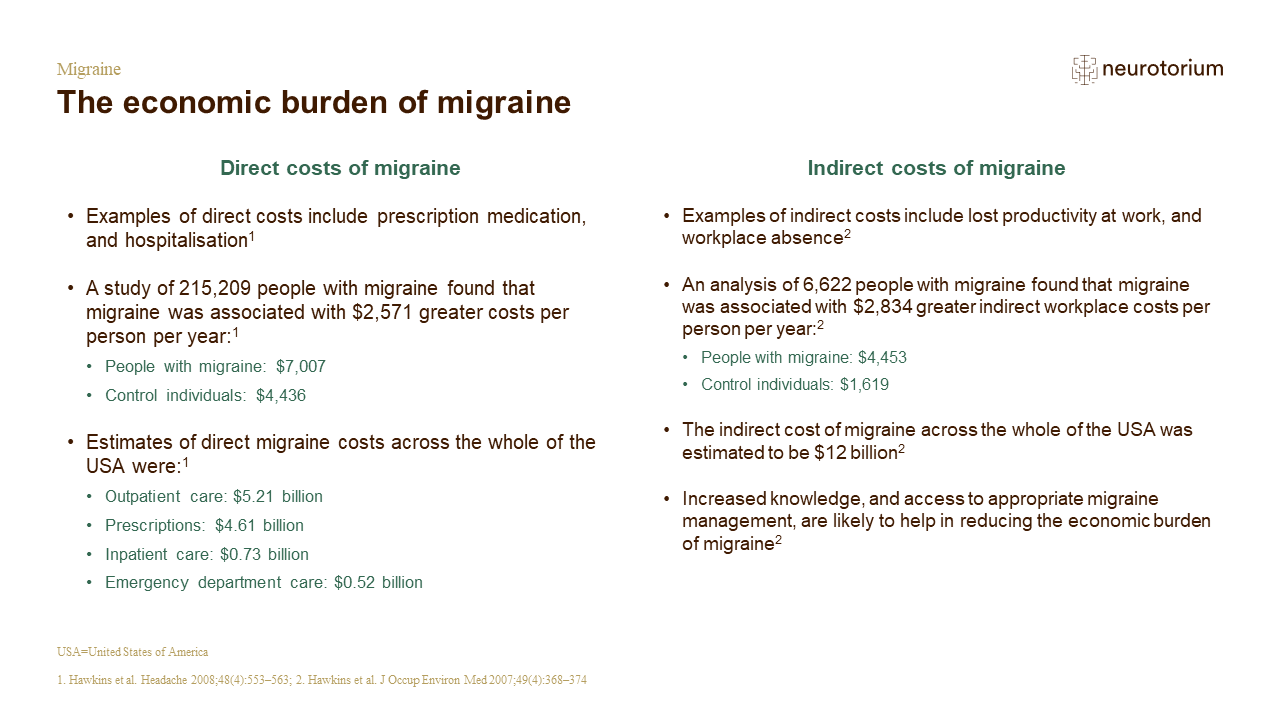
The economic burden of a disease or condition can be broken down into direct and indirect costs.[Phillips, 2005]
Direct costs relate to the use of resources directly as a result of a treatment and healthcare process. Examples include drug costs, costs of nursing, and costs of materials and equipment used in a patient’s treatment.
Indirect costs describe a loss to society resulting from the impact of a disease. Examples include an illness preventing an individual from engaging in normal work activity, or domestic responsibilities.
Reference:
Phillips. Health Economics: An Introduction for Health Professionals. Blackwell, 2005.
Other references used on slide:
Hawkins K, Wang S, Rupnow MF. Indirect cost burden of migraine in the United States. J Occup Environ Med 2007; 49 (4): 368–374.