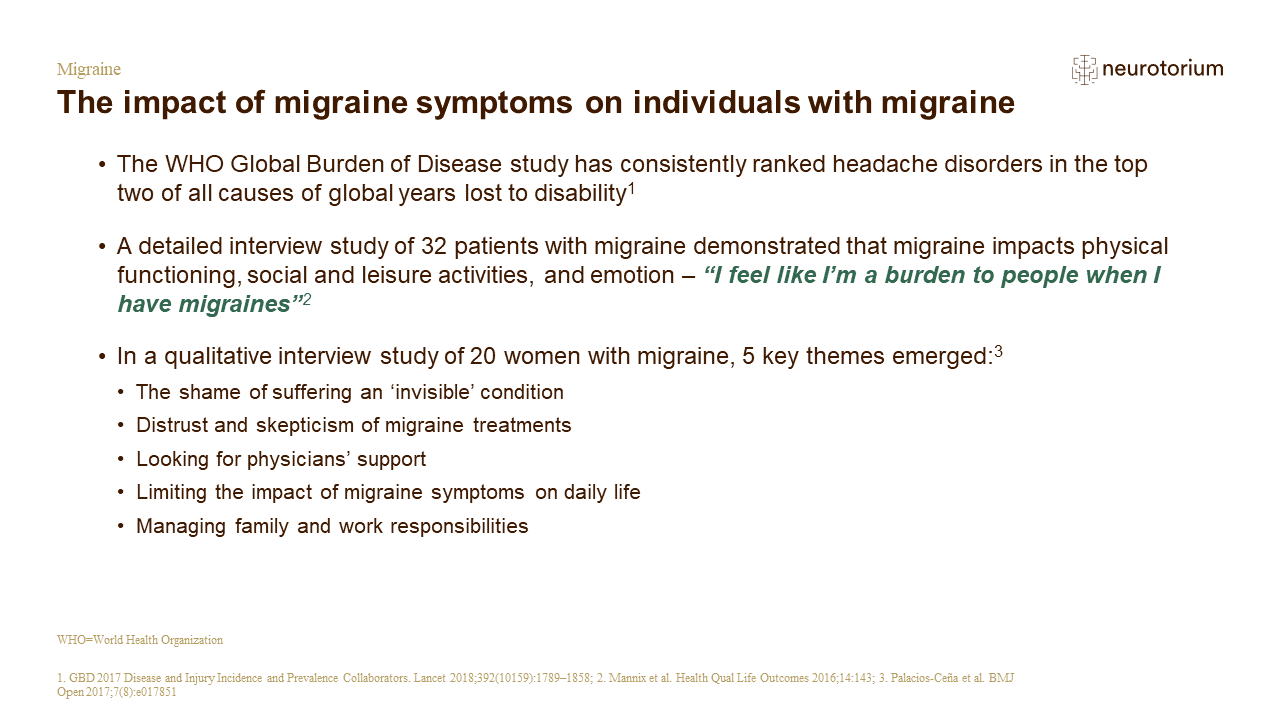
A qualitative interview study, the results of which are outlined on the slide, offered an insight into the way in which patients with chronic migraine experience the disease.[Palacios-Ceña et al., 2017] A key theme that emerged was the frustration that patients feel when they are not able to achieve complete pain relief, whilst also feeling sometimes ashamed of seeking medical care for what they often described as an invisible disease – an invisible disease with a long and difficult route to diagnosis.[Palacios-Ceña et al., 2017]
Reference:
Palacios-Ceña D, Neira-Martín B, Silva-Hernández L, et al. Living with chronic migraine: a qualitative study on female patients’ perspectives from a specialised headache clinic in Spain. BMJ Open 2017; 7 (8): e017851.
Other references used on slide:
GBD 2017 Disease and Injury Incidence and Prevalence Collaborators. Global, regional, and national incidence, prevalence, and years lived with disability for 354 diseases and injuries for 195 countries and territories, 1990–2017: a systematic analysis for the Global Burden of Disease Study 2017. Lancet 2018; 392 (10159): 1789–1858.
Mannix S, Skalicky A, Buse DC, et al. Measuring the impact of migraine for evaluating outcomes of preventive treatments for migraine headaches. Health Qual Life Outcomes 2016; 14 (1): 143.