

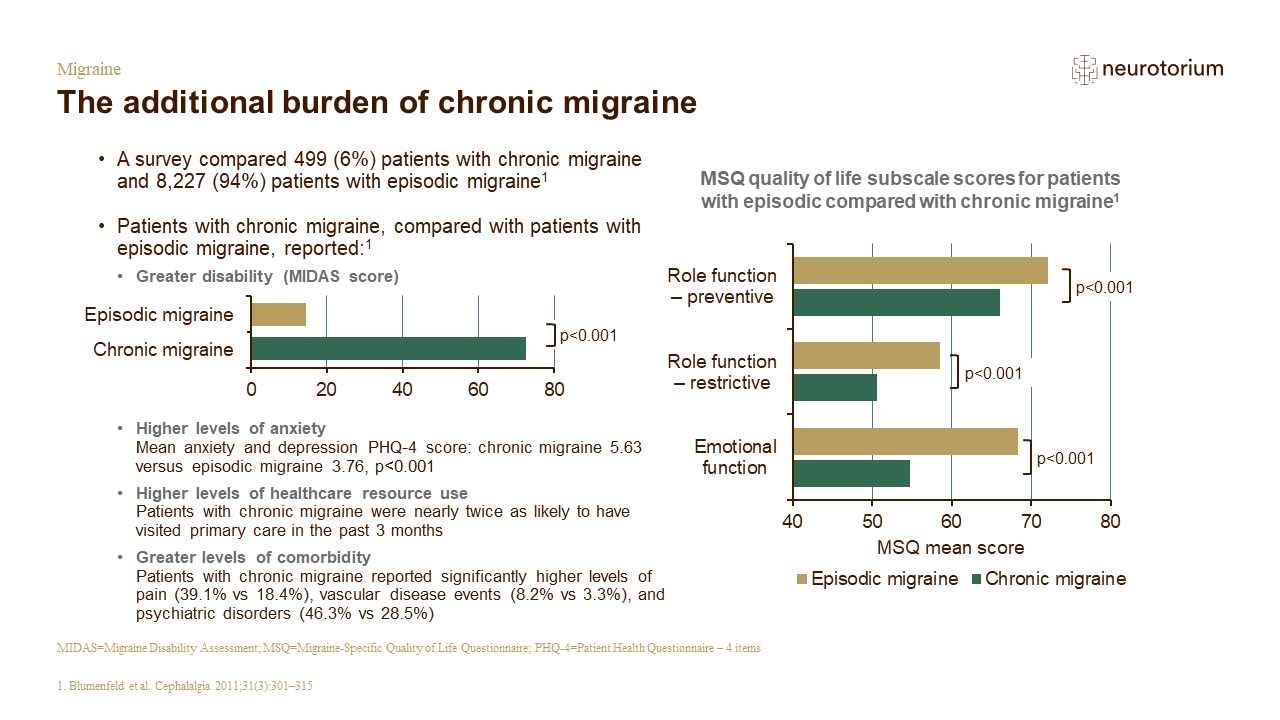
The Migraine-Specific Quality of Life Questionnaire (MSQ) was developed to assess aspects of health-related quality of life believed to be impacted by migraine.[Jhingran et al., 1998]
In the study described on the slide, participants were asked to complete a web-based survey.[Blumenfeld et al., 2011] Of the 63,001 individuals contacted, 8,726 were eligible and completed the survey.[Blumenfeld et al., 2011] In total, 5.7% of the respondents had chronic migraine, whilst 94.3% had episodic migraine.[Blumenfeld et al., 2011] Patients with chronic migraine reported significantly greater disability, lower quality of life, higher levels of anxiety, and also higher levels of healthcare resource use than patients with episodic migraine.[Blumenfeld et al., 2011]
The survey showed that chronic migraine is associated with a great burden on the patient, and on society, which reinforces the importance of preventing the transition from episodic to chronic migraine.[Blumenfeld et al., 2011] These results are in line with data from the American Migraine Prevalence and Prevention (AMPP) study, which have shown that people with chronic migraine had significantly greater chance of experiencing an adverse health impact, compared with people with episodic migraine.[Buse et al., 2012]