

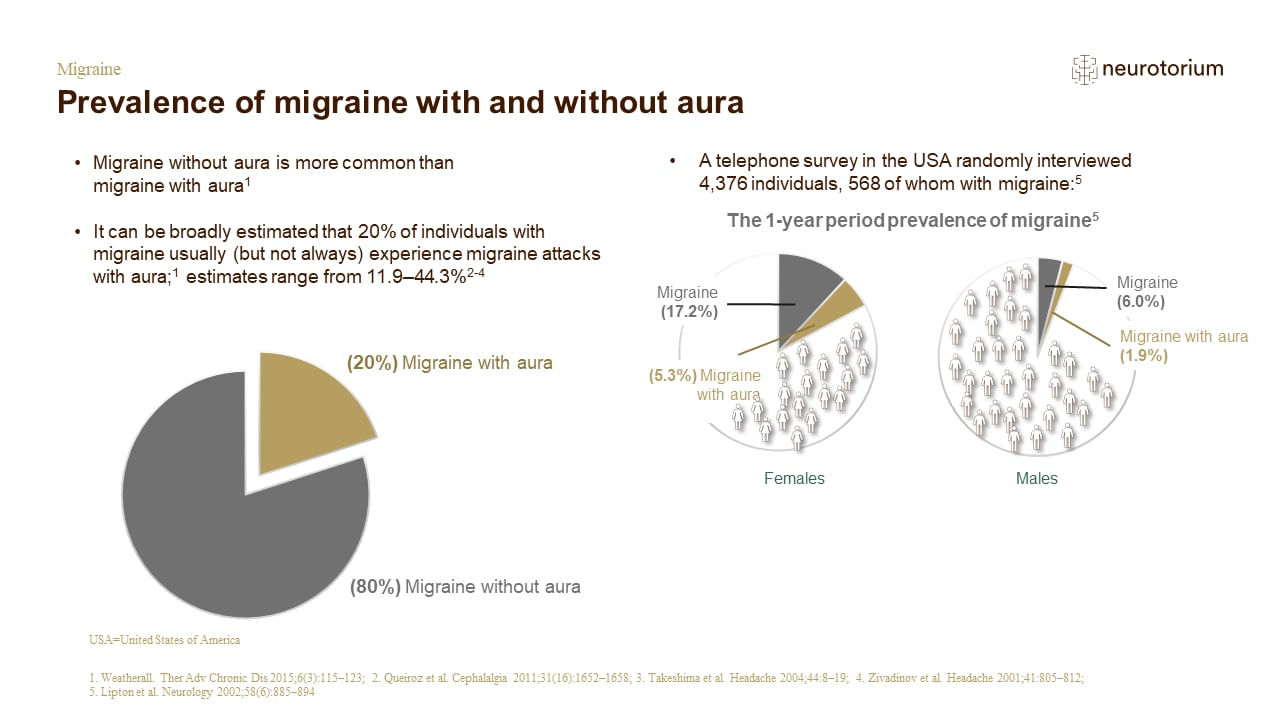
Although estimates vary, approximately 20% of patients with migraine experience aura, albeit not during every attack.[Queiroz et al., 2011; Weatherall, 2015] The aura of migraine is usually visual, and can include flashes of light, moving patterns, or partial loss of vision.[Weatherall, 2015] Less commonly, aura can include tingling, numbness, weakness, or speech difficulties.[Weatherall, 2015]
A retrospective study analysed patient information from two treatment centres, one in Florianopolis, Santa Catarina, Brazil (n=72) and the other in Rochester, New York, USA (n=50).[Queiroz et al., 2011] Of the 122 patients with migraine with aura, 101 (82.8%) were diagnosed with typical aura with migraine headache; 9.0% had typical aura with non-migraine headache; 4.9% had typical aura without headache; and 3.3% had probable migraine with aura.[Queiroz et al., 2011]
Other references used on slide:
Lipton RB, Scher AI, Kolodner K, et al. Migraine in the United States: epidemiology and patterns of health care use. Neurology 2002; 58 (6): 885–894.