

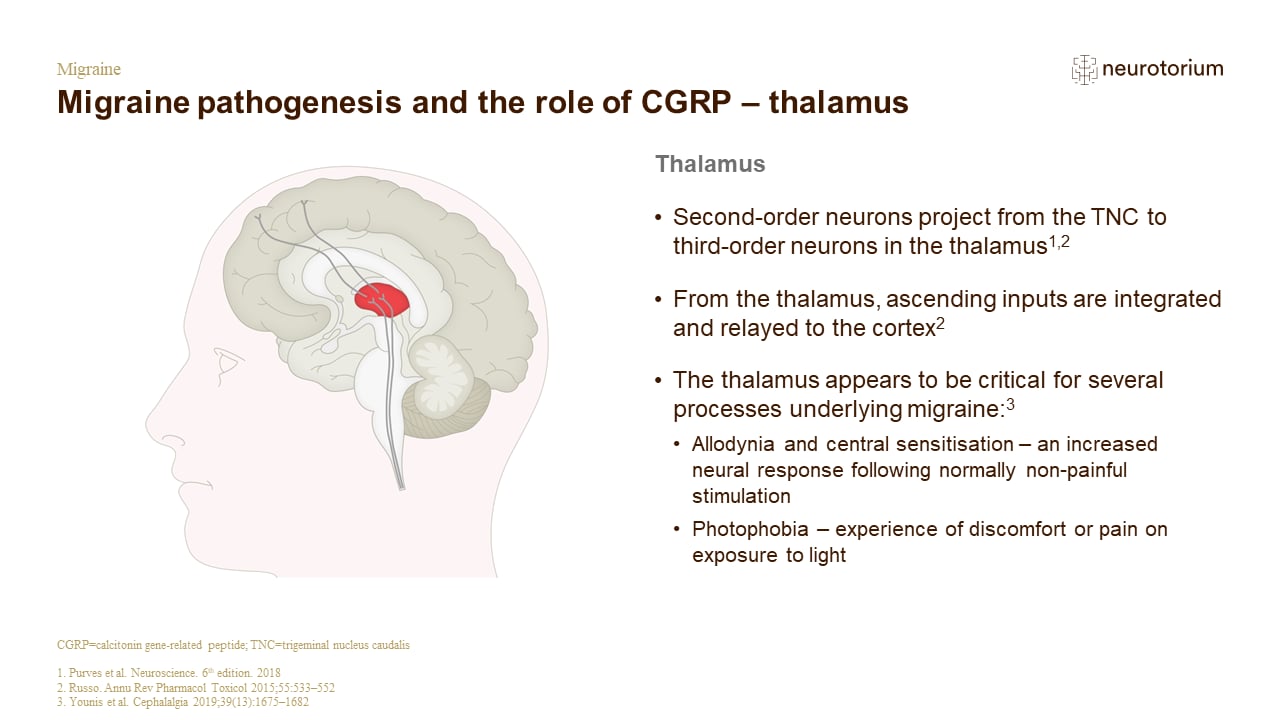
The thalamus is a structure in the brain that relays sensory information (including pain) from the body to the cerebral cortex.[Purves et al., 2018] The thalamus is highly complex but organised, such that the incoming signals remain segregated, based on the type of somatosensory information that is conveyed.[Purves et al., 2018]
Experiments have shown that the cortical trajectories of trigeminovascular neurons are defined by the thalamic nucleus of origin, suggesting separate roles for these pathways in discriminating elements of migraine such as location and intensity of pain, and in symptoms such as phonophobia and photophobia.[Noseda & Burstein, 2013]
Other references used on slide:
Russo AF. Calcitonin gene-related peptide (CGRP): a new target for migraine. Annu Rev Pharmacol Toxicol 2015; 55: 533–552.