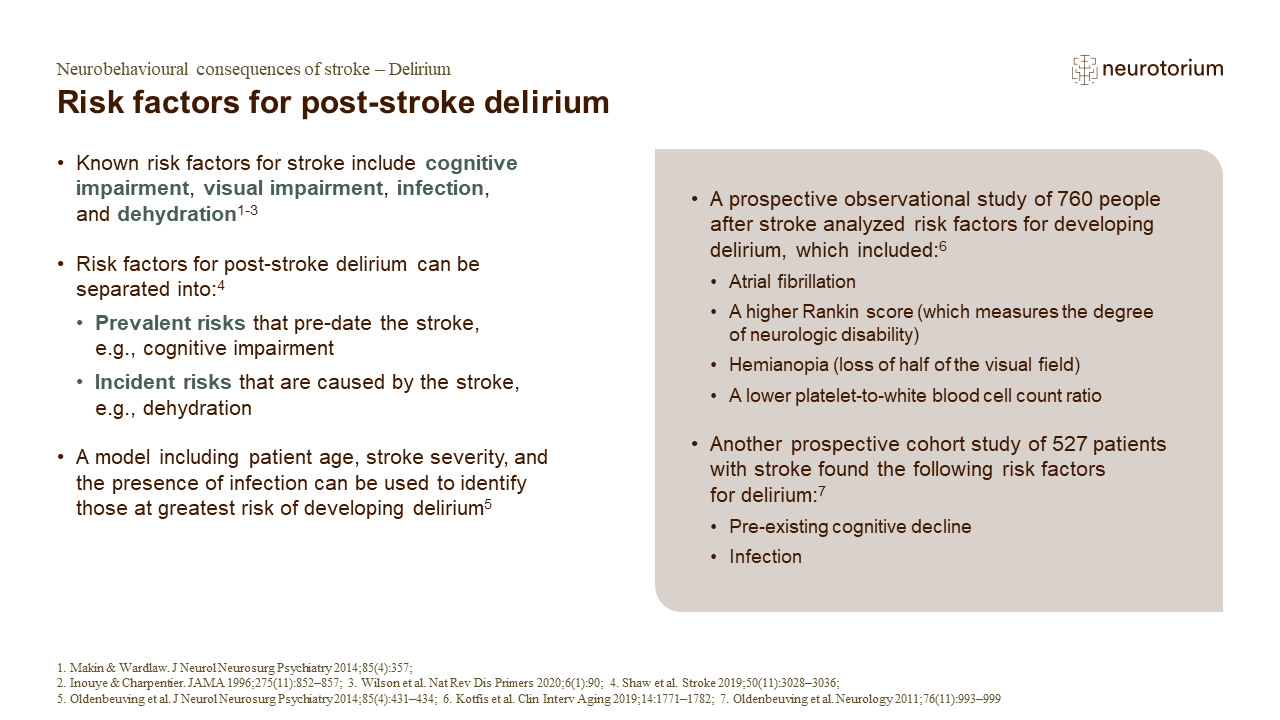
Given the negative effects of delirium on the outcomes of stroke, predicting the risk of a person after stroke of developing delirium is a valuable clinical ambition.1,5 One such tool has been developed that included age, stroke severity and subtype, and the presence of infection as risks.5 These risks can be combined numerically to create a score, which the authors argue can be used easily in clinical practice to allow clinicians to evaluate an individual patient’s delirium risk.5
References:
1. Makin SD, Wardlaw J. Predicting delirium after a stroke. J Neurol Neurosurg Psychiatry 2014; 85 (4): 357.
2. Inouye SK, Charpentier PA. Precipitating factors for delirium in hospitalized elderly persons. Predictive model and interrelationship with baseline vulnerability. JAMA 1996; 275 (11): 852–857.
3. Wilson JE, Mart MF, Cunningham C, et al. Delirium. Nat Rev Dis Primers 2020; 6 (1): 90.
4. Shaw RC, Walker G, Elliott E, Quinn TJ. Occurrence rate of delirium in acute stroke settings: systematic review and meta-analysis. Stroke 2019; 50 (11): 3028–3036.
5. Oldenbeuving AW, de Kort PL, van Eck van der Sluijs JF, Kappelle LJ, Roks G. An early prediction of delirium in the acute phase after stroke. J Neurol Neurosurg Psychiatry 2014; 85 (4): 431–434.
6. Kotfis K, Bott-Olejnik M, Szylińska A, et al. Characteristics, risk factors and outcome of early-onset delirium in elderly patients with first ever acute ischemic stroke – a prospective observational cohort study. Clin Interv Aging 2019; 14: 1771–1782.
7. Oldenbeuving AW, de Kort PL, Jansen BP, et al. Delirium in the acute phase after stroke: incidence, risk factors, and outcome. Neurology 2011; 76 (11): 993–999.