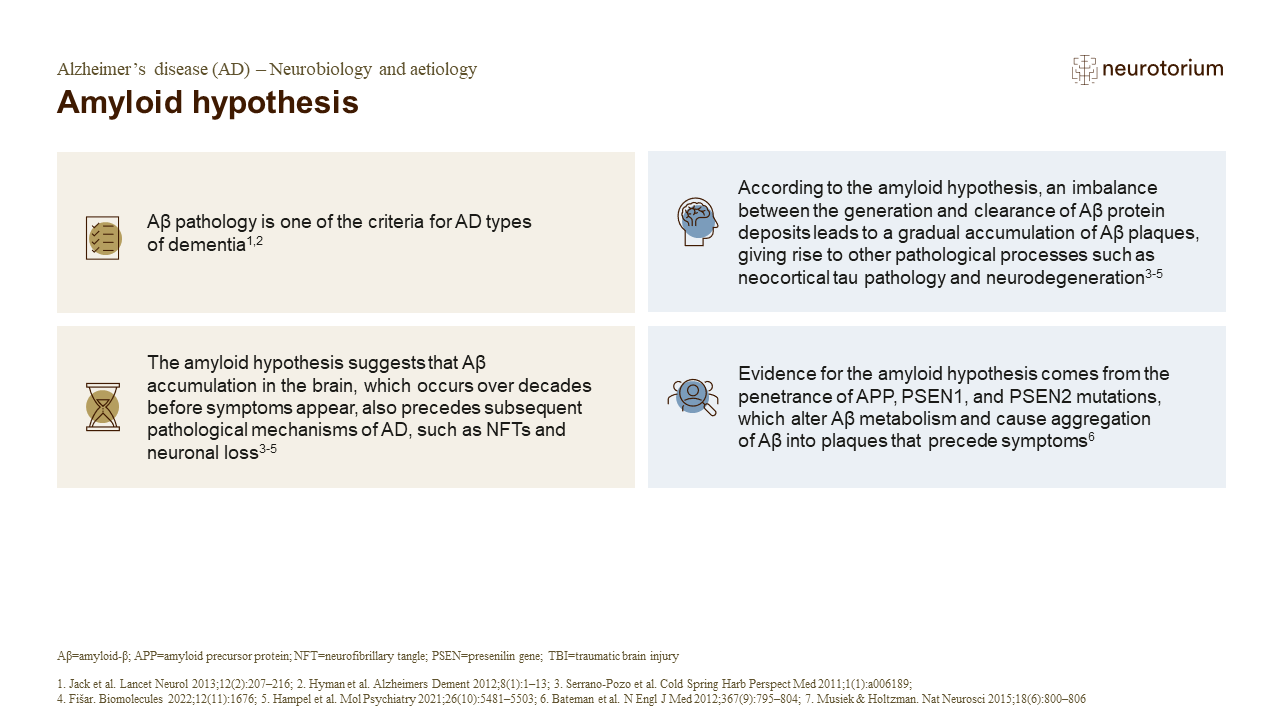
According to the amyloid hypothesis, Aβ aggregation begins with the accumulation of Aβ42 oligomers, which deposit into plaques over time.8 Evidence from human studies suggests that Aβ aggregation starts without causing clinical symptoms.9 Aβ pathology is a necessary but not sufficient condition for AD (i.e., abnormal tau is also required)10
References:
1.Jack CR Jr, Knopman DS, Jagust WJ, et al. Tracking pathophysiological processes in Alzheimer’s disease: an updated hypothetical model of dynamic biomarkers. Lancet Neurol 2013; 12 (2): 207–216.
2.Hyman BT, Phelps CH, Beach TG, et al. National Institute on Aging–Alzheimer’s Association guidelines for the neuropathologic assessment of Alzheimer’s disease. Alzheimers Dement 2012; 8 (1): 1–13.
3.Serrano-Pozo A, Frosch MP, Masliah E, Hyman BT. Neuropathological alterations in Alzheimer disease. Cold Spring Harb Perspect Med 2011; 1 (1): a006189.
4.Fišar Z. Linking the amyloid, tau, and mitochondrial hypotheses of Alzheimer’s Disease and identifying promising drug targets. Biomolecules 2022; 12 (11): 1676.
5.Hampel H, Hardy J, Blennow K, et al. The amyloid-β pathway in Alzheimer’s Disease. Mol Psychiatry 2021; 26 (10): 5481–5503.
6.Bateman RJ, Xiong C, Benzinger TLS, et al; Dominantly Inherited Alzheimer Network. Clinical and biomarker changes in dominantly inherited Alzheimer’s disease. N Engl J Med 2012; 367 (9): 795–804.
7.Musiek ES, Holtzman DM. Three dimensions of the amyloid hypothesis: time, space and ‘wingmen’. Nat Neurosci 2015; 18 (6): 800–806.
8.Selkoe DJ, Hardy J. The amyloid hypothesis of Alzheimer’s disease at 25 years. EMBO Mol Med 2016; 8 (6): 595–608.
9.Jagust W. Is amyloid-β harmful to the brain? Insights from human imaging studies. Brain 2016; 139 (Pt 1): 23–30.
10.Jack CR Jr, Bennett DA, Blennow K, et al. NIA-AA Research Framework: toward a biological definition of Alzheimer’s disease. Alzheimers Dement 2018; 14 (4): 535–562.