

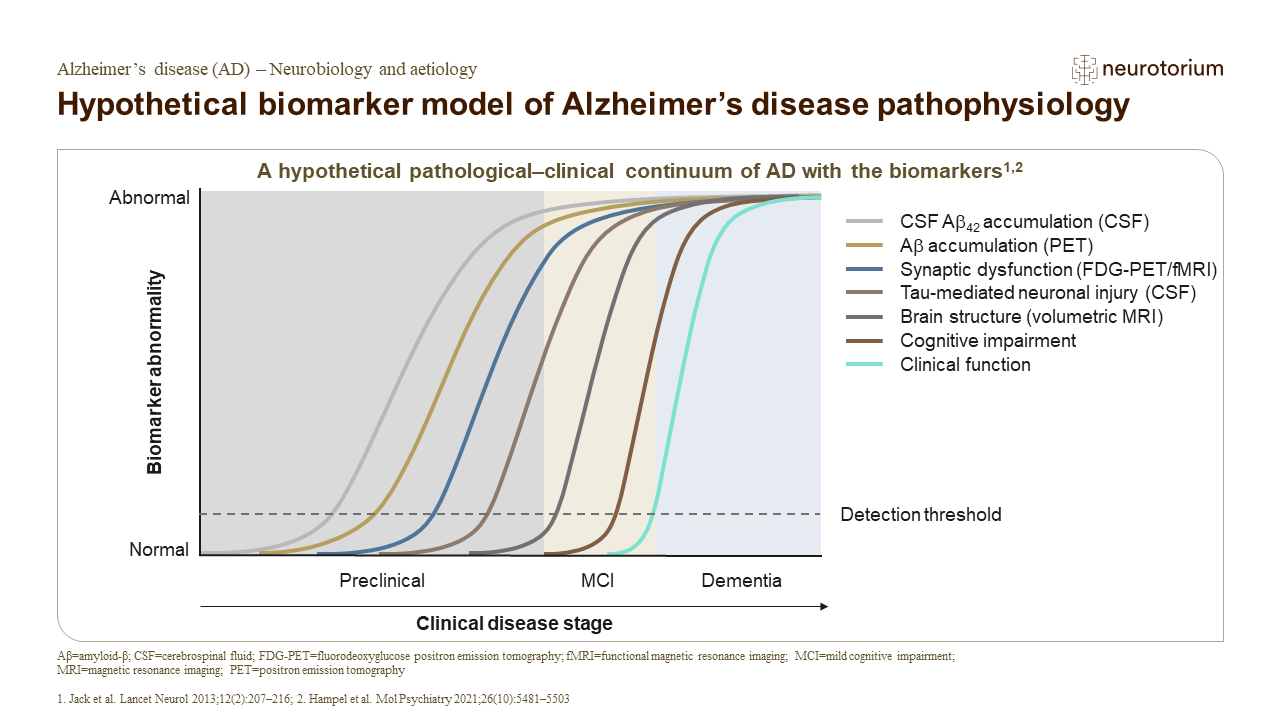
The time-course of biomarker abnormalities and the point at which they become detectable can help determine the primary cause of AD progression.3 The A/T/N biomarker classification system for AD includes three main classes of biomarkers – Aß, tau, and neurodegeneration – and provides the ability to classify biomarker status of an individual independently of their cognitive status.3 Aβ biomarkers include amyloid positron emission tomography (PET) and cerebrospinal fluid (CSF) concentrations of Aß.3 Tau biomarkers include tau-PET and CSF concentrations of phosphorylated P-tau. There are multiple neurodegeneration biomarkers, including fluorodeoxyglucose (FDG)-PET, magnetic resonance imaging (MRI) atrophy, CSF concentrations of total tau and of neurofilament light chain.3
In the preclinical phase, the first measurable evidence of AD is an abnormal reduction in Aß1-42 levels within the CSF due to an increased sequestering of Aβ in the brain parenchyma.4-7 Following this, Aß tracer retention is observed in PET scans, directly reflecting the build-up of amyloid.2,7 As AD progresses, neurodegeneration and synaptic dysfunction can be observed using structural and functional neuroimaging techniques, such as FDG-PET and MRI.2,7 In carriers of the e4 APOE allele, synaptic dysfunction may be observed before detectable Aß accumulation.2 Following this, elevated concentrations of CSF biomarkers that are directly associated with neuronal injury/death, such as t-tau, p-tau181, visinin-like protein 1 (VILIP-1) and neurogranin, are detected.1,2 Continuation of disease results in hippocampal and entorhinal cortex atrophy and cortical thinning that can be detected by volumetric MRI.5,7,8 As with Aß biomarkers, these biomarkers may be detected in individuals at high risk of AD many decades before cognitive decline occurs.7,9 The MCI phase represents the first symptomatic occurrence in AD, with patients experiencing a decline or plateau in Aß accumulation,10,11 and continued tau accumulation and neurodegeneration.7 The progression of AD pathology results in a display of cognitive deficits, with memory and executive function often being the most affected cognitive domains.7 For most patients with MCI due to AD pathology, the subsequent stage is AD dementia, which is a decline in clinical function, and represents the late stages of disease.7 At this stage, Aß and tau accumulation are at their maximum, changes in brain structure continue, and neurodegeneration becomes macroscopically evident.7