

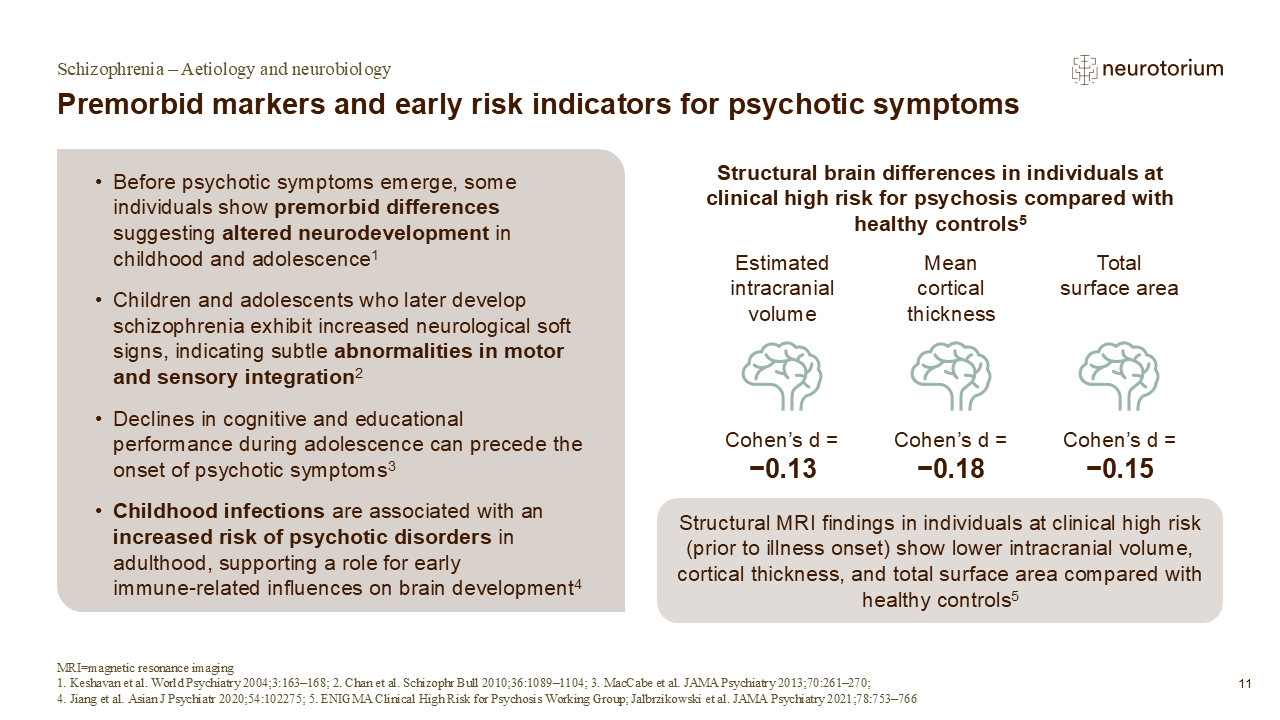
The study by ENIGMA Clinical High Risk for Psychosis Working Group pooled MRI data from 31 international sites, including 1,792 individuals at CHR and 1,377 healthy controls, giving a total sample of 3,169 participants. Among the CHR group, longitudinal clinical follow‑up identified 253 individuals who later developed psychosis (CHR‑PS+) and 1,234 who did not (CHR‑PS−).5
Structural MRI measures were extracted using harmonized FreeSurfer analysis software, including regional cortical thickness, surface area, subcortical volumes, and global measures (mean cortical thickness, total surface area, and intracranial volume). Group differences were assessed within a mega‑analysis framework, with effect sizes reported as Cohen’s d with 95% confidence intervals and correction for multiple comparisons.5
Abbreviations: CHR=clinical high risk; MRI=magnetic resonance imaging
References:
1. Keshavan MS, Diwadkar VA, Montrose DM, et al. Premorbid characterization in schizophrenia: the Pittsburgh High Risk Study. World Psychiatry 2004; 3: 163–168.
2. Chan RC, Xu T, Heinrichs RW, et al. Neurological soft signs in schizophrenia: a meta-analysis. Schizophr Bull 2010; 36: 1089–1104.
3. MacCabe JH, Wicks S, Löfving S, et al. Decline in cognitive performance between ages 13 and 18 years and the risk for psychosis in adulthood: a Swedish longitudinal cohort study in males. JAMA Psychiatry 2013; 70: 261–270.
4. Jiang HY, Zhang X, Pan LY, Ma YC. Childhood infection and subsequent risk of psychotic disorders in adults: a systematic review and meta-analysis. Asian J Psychiatr 2020; 54: 102275.
5. ENIGMA Clinical High Risk for Psychosis Working Group; Jalbrzikowski M, Hayes RA, et al. Association of structural magnetic resonance imaging measures with psychosis onset in individuals at clinical high risk for developing psychosis: an ENIGMA Working Group mega-analysis. JAMA Psychiatry 2021; 78: 753–766.