

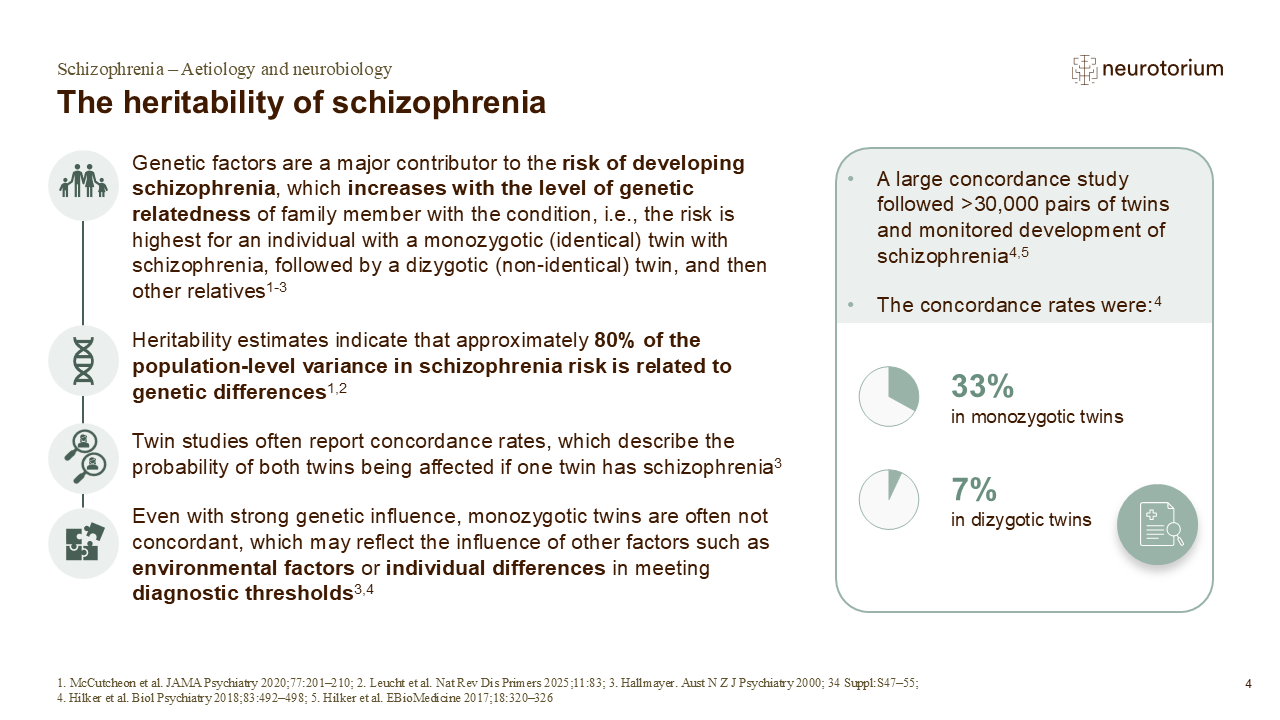
Differences between heritability estimates and concordance rates arise due to heritability and concordance rates capturing different aspects of genetic contribution to schizophrenia risk, with heritability reflecting population-level variance in risk and concordance reflecting the likelihood of co-occurrence within individuals.1,3
In the large concordance study by Hilker et al., which followed more than 30,000 pairs of twins, the researchers also examined factors that might influence differences in risk within twin pairs.4 It was found that early onset of schizophrenia in one twin was a risk factor of the second twin developing schizophrenia as well. This suggests that early‑onset schizophrenia may have a stronger genetic component of risk than other subtypes of schizophrenia.4 Overall, these results demonstrate that there is a high genetic component to the risk of developing schizophrenia; however, vulnerability to the illness is not solely genetic.4,5
References:
1. McCutcheon RA, Reis Marques T, Howes, OD. Schizophrenia-an overview. JAMA Psychiatry 2020; 77: 201–210.
2. Leucht S, Siafis S, McGrath JJ, et al. Schizophrenia. Nat Rev Dis Primers 2025; 11: 83.
3. Hallmayer J. The epidemiology of the genetic liability for schizophrenia. Aust N Z J Psychiatry 2000; 34 Suppl: S47–S57.
4. Hilker R, Helenius D, Fagerlund B, et al. Is an early age at illness onset in schizophrenia associated with increased genetic susceptibility? Analysis of data from the nationwide Danish twin register. EBioMedicine 2017; 18: 320–326.
5. Hilker R, Helenius D, Fagerlund B, et al. Heritability of schizophrenia and schizophrenia spectrum based on the nationwide Danish twin register. Biol Psychiatry 2018; 83: 492–498.