

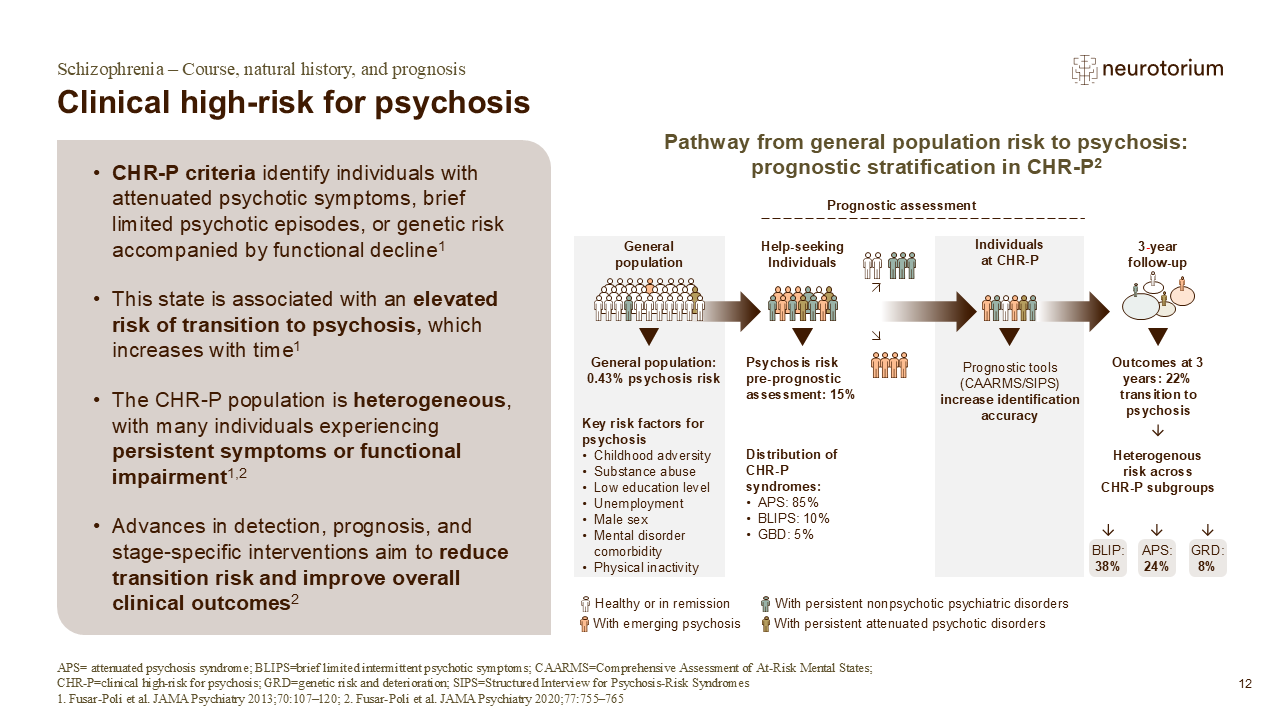
Several assessment tools have been developed to identify individuals at clinical high risk for psychosis, particularly in the early stages before a full psychotic disorder emerges. Three key assessment tools are described below.
- The CAARMS is a semi-structured interview designed to assess subthreshold psychotic symptoms, functional decline, and other risk indicators to determine whether an individual meets criteria for an at-risk mental state.3
- The SIPS evaluates attenuated psychotic syndromes, brief intermittent psychotic symptoms, and genetic risk combined with functional deterioration.4
- The Mini-SIPS is a shorter screening version of SIPS developed to provide a more time-efficient method for identifying possible psychosis-risk syndromes in clinical settings while maintaining alignment with the SIPS criteria.4
Abbreviations: CAARMS=Comprehensive Assessment of At-Risk Mental States; SIPS=Structured Interview for Psychosis-Risk Syndromes
References:
1. Fusar-Poli P, Borgwardt S, Bechdolf A, et al. The psychosis high-risk state: a comprehensive state-of-the-art review. JAMA Psychiatry 2013; 70: 107–120.
2. Fusar-Poli P, Salazar de Pablo G, Correll CU, et al. Prevention of psychosis: advances in detection, prognosis, and intervention. JAMA Psychiatry 2020; 77: 755–765.
3. Orygen. Comprehensive Assessment of At-Risk Mental States (CAARMS 23) Toolkit. https://www.orygen.org.au/Training/Resources/Psychosis/CAARMS-Toolkit/CAARMS-23.
4. Woods S, Lympus C, McGlashan TH, et al. The Mini-SIPS: development of a brief clinical structured interview guide to diagnosing DSM-5 Attenuated Psychosis Syndrome and training outcomes. BMC Psychiatry 2022; 22: 784.