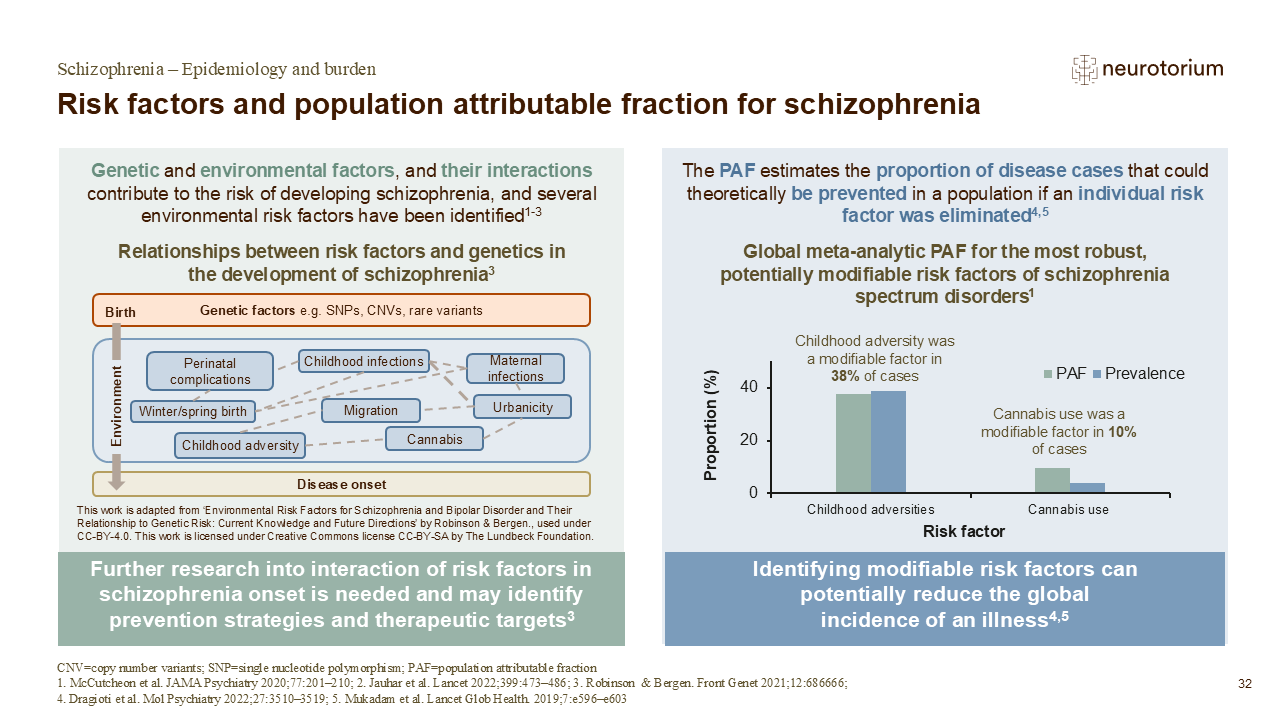
PAF estimates the epidemiologic contribution of a risk factor to a certain disease. It is calculated using the relative risk of a disease associated with a risk factor and the prevalence of that risk factor.1,2
Abbreviation: PAF=population attributable fraction
References:
1.McCutcheon RA, Reis Marques T, Howes, OD. Schizophrenia-an overview. JAMA Psychiatry 2020; 77: 201–210.
2.Jauhar S, Johnstone M, McKenna PJ. Schizophrenia. Lancet 2022; 399: 473–486.
3.Robinson N & Bergen SE. Environmental Risk Factors for Schizophrenia and Bipolar Disorder and Their Relationship to Genetic Risk: Current Knowledge and Future Directions. Front Genet 2021; 12: 686666.
4.Dragioti E, Radua J, Solmi M, et al. Global population attributable fraction of potentially modifiable risk factors for mental disorders: a meta-umbrella systematic review. Mol Psychiatry 2022; 27: 3510–3519.
5.Mukadam N, Sommerlad A, Huntley J, Livingston G. Population attributable fractions for risk factors for dementia in low-income and middle-income countries: an analysis using cross-sectional survey data. Lancet Glob Health 2019; 7: e596–e603.