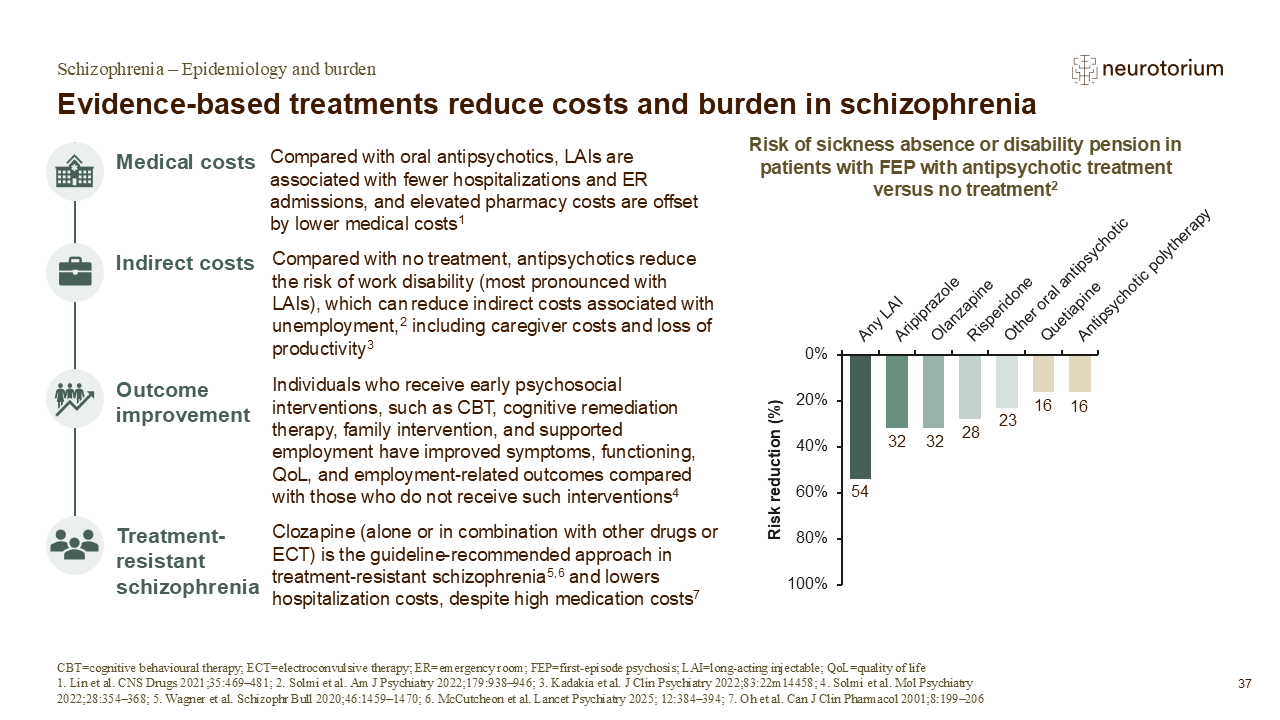
The concept of cost offset in schizophrenia evaluates whether pharmacological treatment costs are balanced by reductions in non-pharmacological direct and indirect costs, such as reduced hospitalizations and reduced caregiver burden, as a result of treatment efficacy. When these costs are similar, there is no net change in overall healthcare costs.1 There is strong evidence of treatment efficacy and cost offset with evidence-based schizophrenia interventions, including in overall and treatment-resistant populations, as shown on the slide.
A meta-analysis of 25 real-world studies demonstrated that, compared with oral antipsychotics, patients initiated on a LAI had lower odds of hospitalization, fewer hospitalizations, and fewer emergency room admissions. The initiation of a LAI was associated with higher per-patient-per-year pharmacy costs (mean difference: $5,603), which was offset by lower per-patient-per-year medical costs (mean difference: −$5,404), resulting in no significant net difference in per-patient-per-year total all-cause healthcare costs between patients treated with LAIs and those treated with oral antipsychotics (mean difference: $327).1
Abbreviations: LAI=long-acting injectable
References:
1.Lin D, Thompson-Leduc P, Ghelerter I, et al. Real-World evidence of the clinical and economic impact of long-acting injectable versus oral antipsychotics among patients with schizophrenia in the United States: a systematic review and meta-analysis. CNS Drugs 2021; 35: 469–481.
2.Solmi M, Taipale H, Holm M, et al. Effectiveness of antipsychotic use for reducing risk of work disability: results from a within-subject analysis of a Swedish national cohort of 21,551 patients with first-episode nonaffective psychosis. Am J Psychiatry. 2022; 179: 938–946.
3.Solmi M, Croatto G, Piva G, et al. Efficacy and acceptability of psychosocial interventions in schizophrenia: systematic overview and quality appraisal of the meta-analytic evidence. Mol Psychiatry 2023; 28: 354–368.
4.Kadakia A, Catillon M, Fan Q, et al. The economic burden of schizophrenia in the United States. J Clin Psychiatry 2022; 83 : 22m14458.
5.Wagner E, Kane JM, Correll CU, et al. Clozapine combination and augmentation strategies in patients with schizophrenia – recommendations from an international expert survey among the Treatment Response and Resistance in Psychosis (TRRIP) Working Group. Schizophr Bull 2020; 46: 1459–1470.
6.McCutcheon RA, Pillinger T, Varvari I, et al. INTEGRATE: international guidelines for the algorithmic treatment of schizophrenia. Lancet Psychiatry 2025; 12: 384–394.
7.Oh PI, Iskedjian M, Addis A, et al. Pharmacoeconomic evaluation of clozapine in treatment-resistant schizophrenia: a cost-utility analysis. Can J Clin Pharmacol 2001; 8: 199–206.