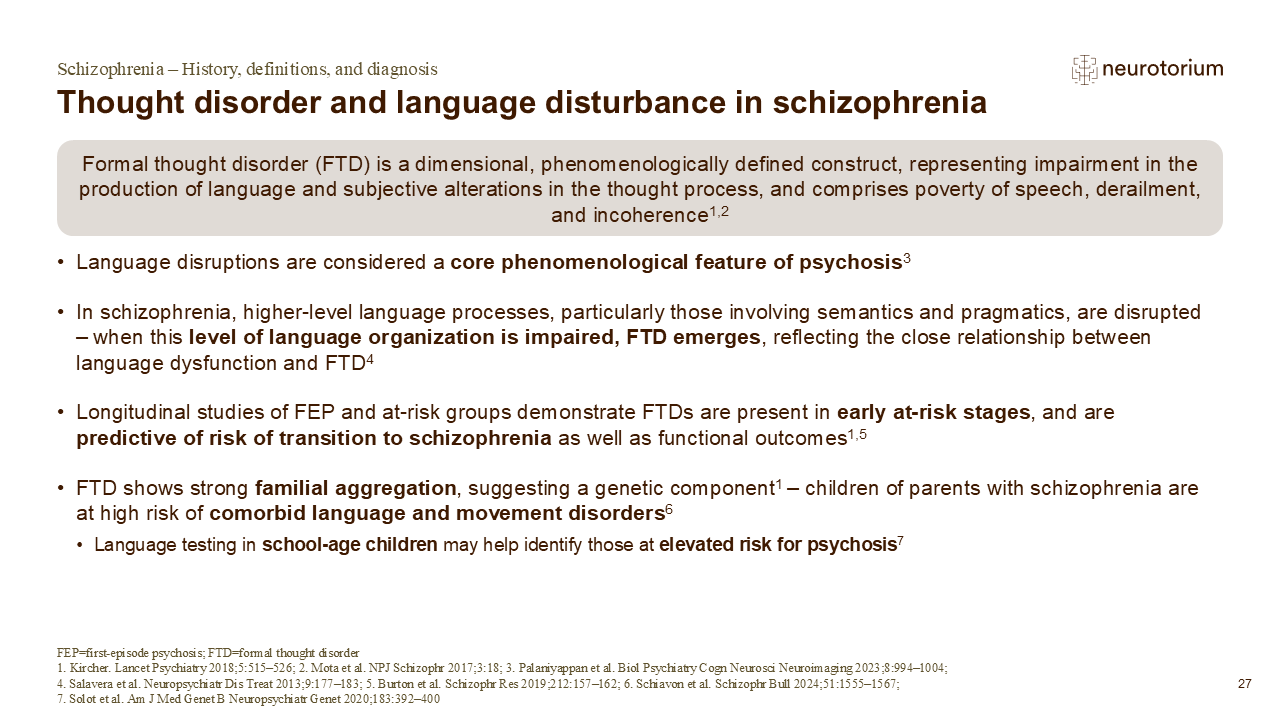
FTD can be subdivided into positive versus negative and objective versus subjective symptom clusters. Positive symptoms include derailment and loosening of associations, an increased amount of produced speech (e.g., logorrhoea, pressured speech), the use of new words (neologisms), and stilted speech phenomena (manneristic speech). Negative FTD has been conceptualized as a quantitative deficit in speech and thought production (e.g., poverty of speech, slowed thinking). Subjective positive FTDs include pressure of thoughts and thought interference. Subjective negative FTDs include inhibited thinking and dysfunction of thought initiative, respectively.1
Abbreviations: FTD=formal thought disorder
References:
1.Kircher T, Bröhl H, Meier F, Engelen J. Formal thought disorders: from phenomenology to neurobiology. Lancet Psychiatry 2018; 5: 515–526.
2.Mota NB, Copelli M, Ribeiro S. Thought disorder measured as random speech structure classifies negative symptoms and schizophrenia diagnosis 6 months in advance. NPJ Schizophr 2017; 3: 18.
3.Palaniyappan L, Benrimoh D, Voppel A, Rocca R. Studying psychosis using natural language generation: a review of emerging opportunities. Biol Psychiatry Cogn Neurosci Neuroimaging 2023 ; 8: 994–1004.
4.Salavera C, Puyuelo M, Antoñanzas JL, Teruel P. Semantics, pragmatics, and formal thought disorders in people with schizophrenia. Neuropsychiatr Dis Treat 2013; 9: 177–183.
5.Burton CZ, Tso IF, Carrión RE et al. Baseline psychopathology and relationship to longitudinal functional outcome in attenuated and early first episode psychosis. Schizophr Res 2019; 212: 157–162.
6.Schiavon M, Burton BK, Hemager N et al. Language, motor ability and related deficits in children at familial risk of schizophrenia or bipolar disorder. Schizophr Bull 2025; 51: 1555–1567.
7.Solot CB, Moore TM, Crowley TB et al. Early language measures associated with later psychosis features in 22q11.2 deletion syndrome. Am J Med Genet B Neuropsychiatr Genet 2020; 183: 392–400.