

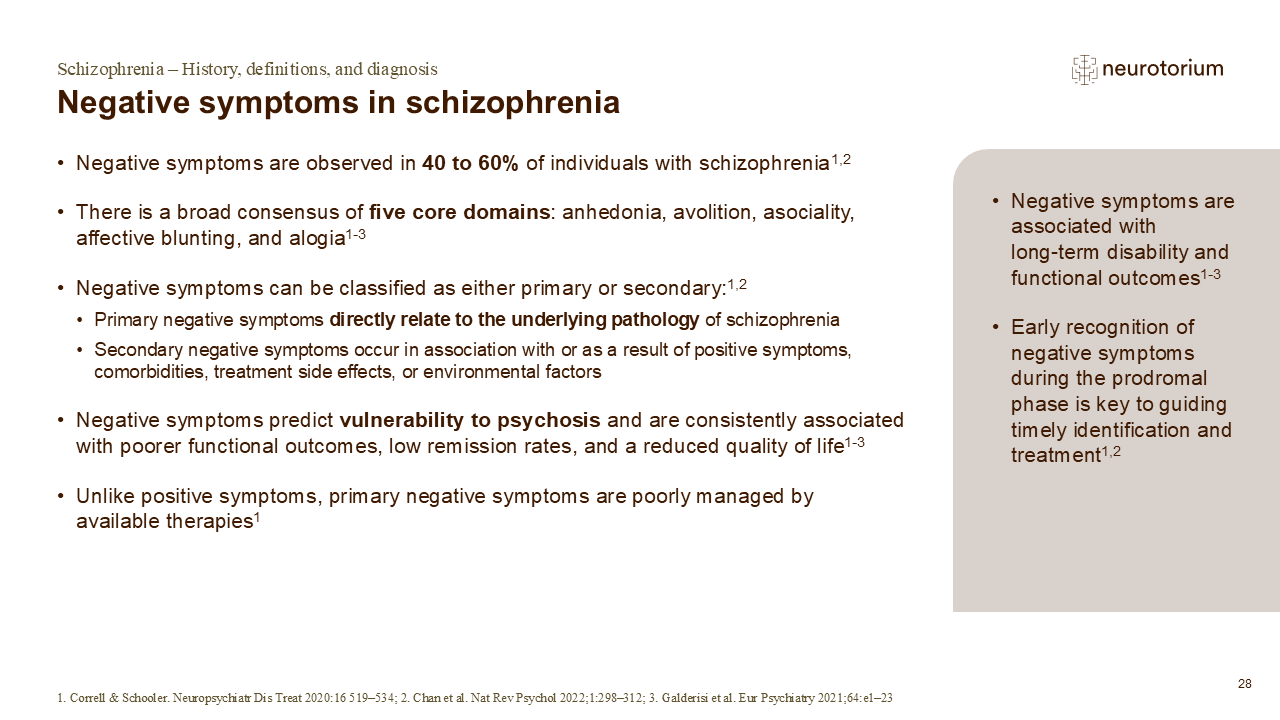
The five key constructs of negative symptoms include anhedonia (difficulty or inability to anticipate future pleasure, few leisure activities, lack of interest in sexual activity), avolition (emotional withdrawal, apathy, poor grooming and hygiene, less involvement with work/school), asociality (few friends, poor relationships with friends, lack of motivation for relationships, reduced social interaction), affective blunting (diminished facial and vocal expressions, poor eye contact, minimal use of gestures), alogia (short or monosyllable answers to questions avoids communication, uses few words).1 These constructs can be categorized into two independent factors: diminished expression (includes blunted affect and alogia) and avolition/apathy (includes avolition, asociality, and anhedonia).1
The presence of negative symptoms is not mandatory for a schizophrenia diagnosis; however, diminished expression and avolition are one of the five symptom criteria taken into consideration in the Diagnostic and Statistical Manual of Mental Disorders-5.1 Despite this, clinical recognition of negative symptoms is challenging because patients with schizophrenia may not be aware of the impact of negative symptoms and they rarely present with negative symptom complaints.1 Diminished expression may become apparent during a clinical interview, while avolition may be deducible from inquiry into a person’s behaviors outside the interview setting, which may be suggestive of poor functioning in work, school relationships or self-care.1
Negative symptom assessment has evolved from older scales like PANSS, SANS, and NSA‑16, which use single‑timepoint ratings and include items now seen as irrelevant to the negative symptom domain, to newer instruments such as CAINS and BNSS that align with the five core constructs.1 More recently, brief easy-to-use tools like the NSA‑4 were developed to allow rapid screening and assessment in routine clinical practice.1
Abbreviation: BNSS=Brief Negative Symptom Scale; CAINS=Clinical Assessment Interview for Negative Symptoms; NSA‑16=16‑item Negative Symptom Assessment; NSA‑4=4‑item Negative Symptom Assessment; PANSS=Positive and Negative Syndrome Scale
References: