

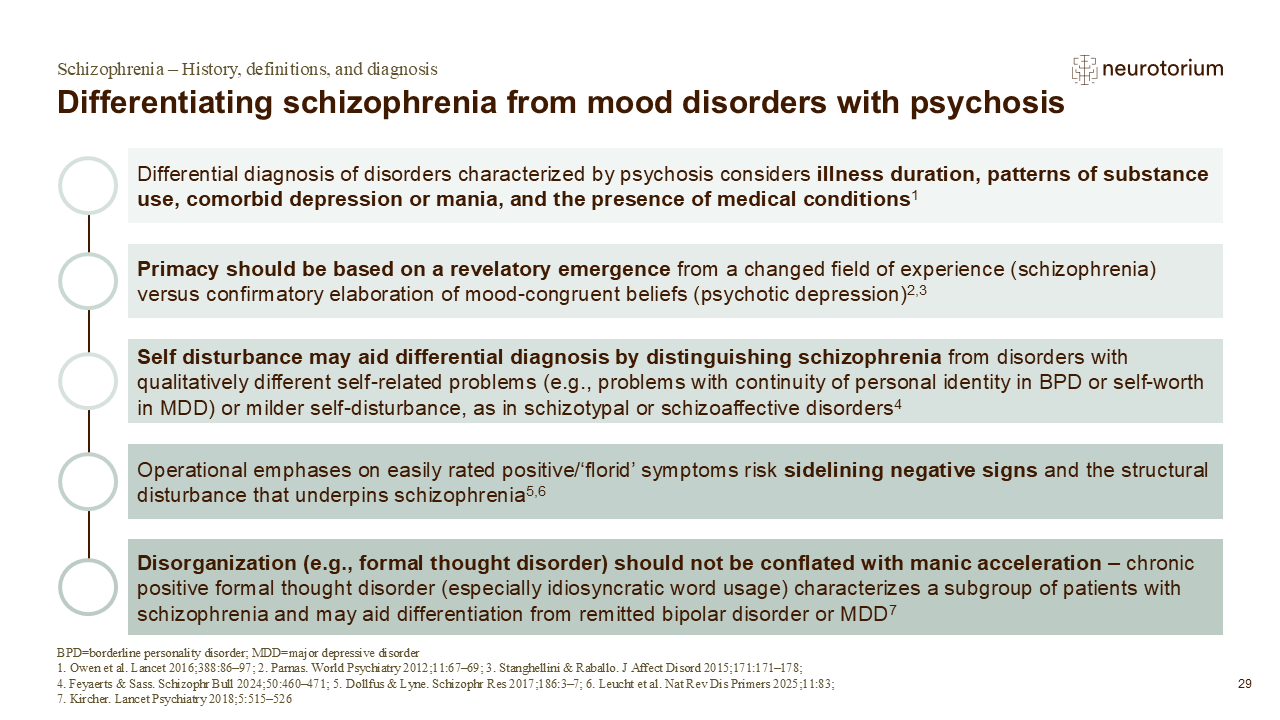
Per the DSM-5, schizophrenia is diagnosed when:
- Psychotic symptoms are persistent and not caused by substances, medications, medical conditions, delirium, or neurocognitive disorders; timing of symptoms helps distinguish these other causes8
- Schizoaffective disorder and depressive or bipolar disorder with psychotic features are ruled out as major depressive or manic episodes were either absent during active psychosis or limited to a minority of the total illness duration8
Abbreviations: DSM-5=Diagnostic and Statistical Manual for Mental Disorders; fifth revision
References:
1.Owen MJ, Sawa A, Mortensen PB. Schizophrenia. Lancet 2016; 388: 86–97.
2.Parnas J. The core Gestalt of schizophrenia. World Psychiatry 2012; 11: 67–69.
6.Leucht S, Siafis S, McGrath JJ et al. Schizophrenia. Nat Rev Dis Primers 2025; 11: 83.