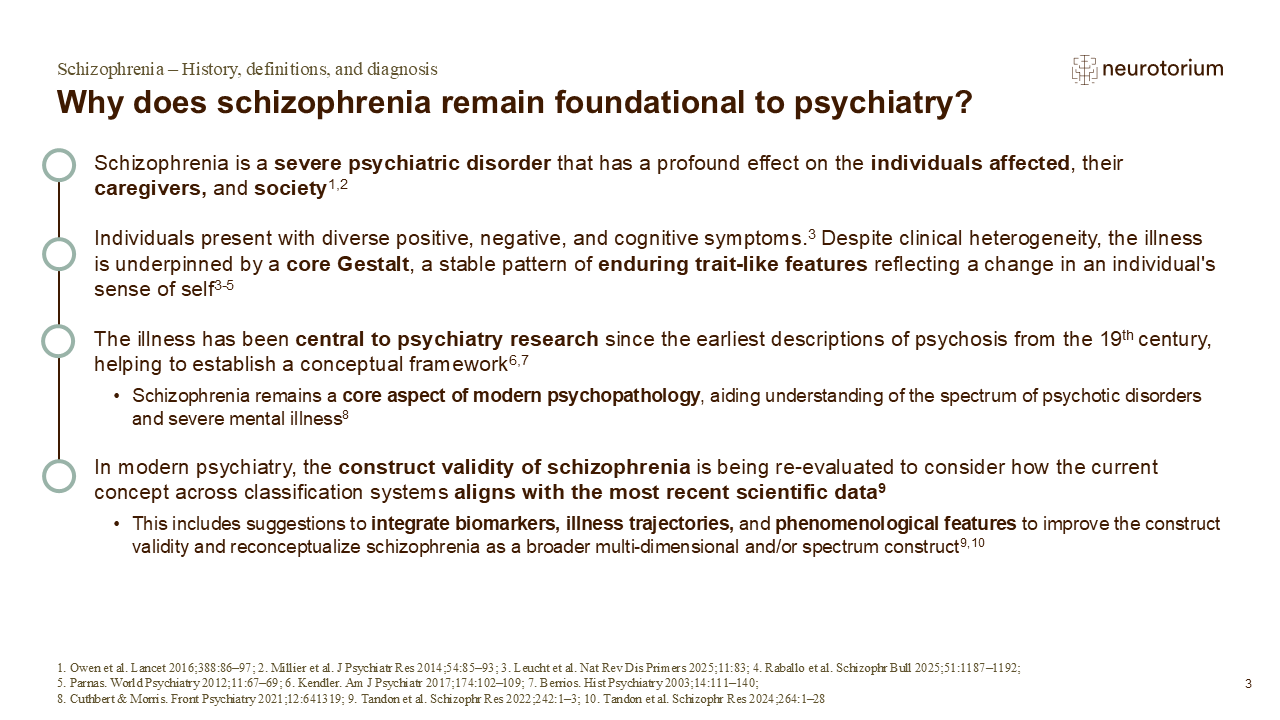
Schizophrenia cannot be understood by counting symptoms (such as hallucinations, delusions, etc.), but rather by recognizing a pattern of change in the structure of an individual’s sense of self.5 This pattern, or Gestalt, suggests symptoms are not mutually independent but are interconnected and can only be understood in the context of an alteration in a basic and foundational self-world structure of subjectivity.5 As such, schizophrenia is characterized by an enduring trait-like disturbance of self, a global transformation in subjectivity and phenomenological structure, affecting expression, affect, motivation, mood, cognition, and action.4,5
References:
1.Owen MJ, Sawa A, Mortensen PB. Schizophrenia. Lancet 2016; 388: 86–97.
2.Millier A, Schmidt U, Angermeyer MC, et al. Humanistic burden in schizophrenia: a literature review. J Psychiatr Res 2014; 54: 85–93.
3.Leucht S, Siafis S, McGrath JJ, et al. Schizophrenia. Nat Rev Dis Primers 2025;11:83.
4.Raballo A, Henriksen MG, Poletti M, Parnas J. “Schizophrenia, consciousness, and the self” Twenty years later: revisiting the ipseity-disturbance model and the developmental nature of self-disorder in the schizophrenia spectrum. Schizophr Bull 2025; 51: 1187–1192.
5.Parnas J. The core gestalt of schizophrenia. World Psychiatry 2012; 11: 67–69.
6.Kendler KS. Kahlbaum, Hecker, and Kraepelin and the transition from psychiatric symptom complexes to empirical disease forms. Am J Psychiatry 2017; 174: 102–109.
7.Berrios GE. Schizophrenia: a conceptual history. Hist Psychiatry 2003; 14: 111–140.
8.Cuthbert BN & Morris SE. The Research Domain Criteria (RDoC): an analysis of methodological and conceptual challenges. Front Psychiatry 2021; 12: 641319.
9.Tandon R Keshavan M, Nasrallah H. Reinventing schizophrenia: updating the construct. Schizophr Res 2022; 242: 1–3.
10.Tandon R, Nasrallah H, Akbarian S, et al. The schizophrenia syndrome, circa 2024: what we know and how that informs its nature. Schizophr Res 2024; 264: 1–28.