

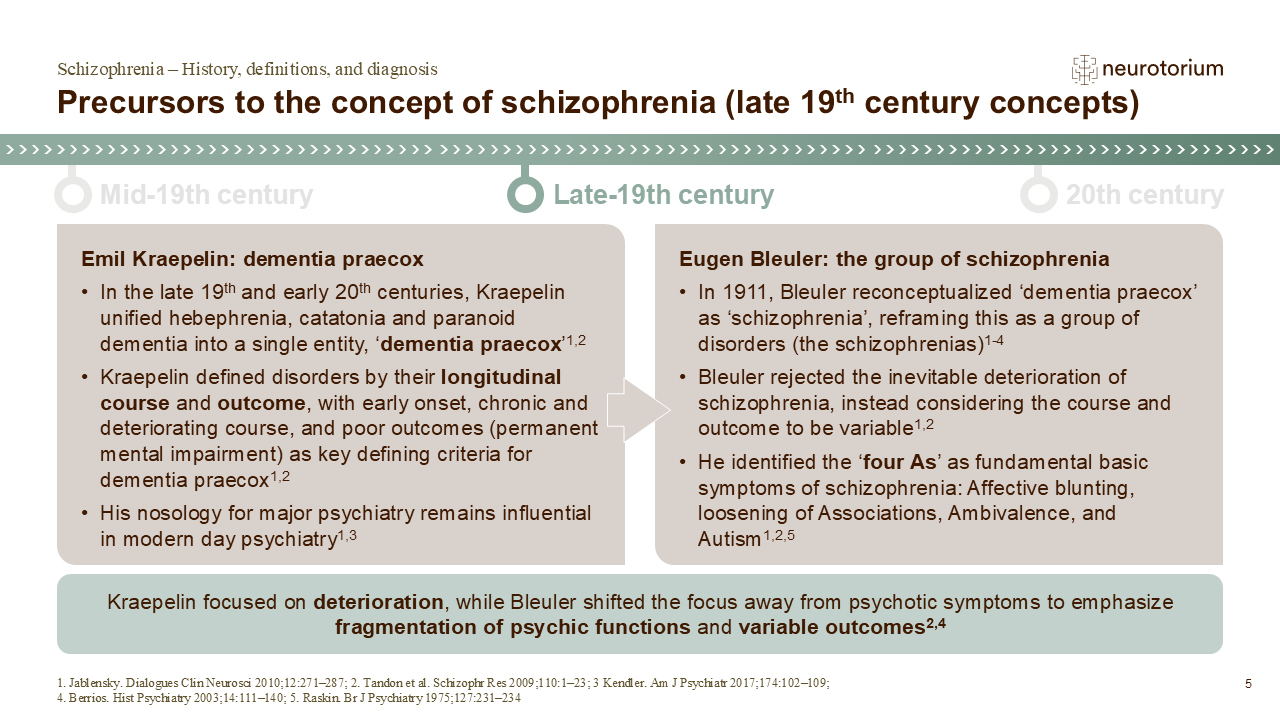
Bleuler reconceptualized Kraepelin’s original idea by adding to its scope of clinical illnesses which did not evolve into the kind of ‘terminal state’ of deterioration, considered by Kraepelin to be a defining feature of the disease.1 Bleuler introduced a fundamental distinction between basic (obligatory) and accessory (supplementary) symptoms of the schizophrenia. While the accessory symptoms comprised the delusions and hallucinations that today are commonly classified as ‘positive’ symptoms, the basic symptoms, which would be considered ‘negative’ symptoms today, included thought and speech derailment (‘loosening of associations’), volitional indeterminacy (‘ambivalence’), affective incongruence, and withdrawal from reality (‘autism’).1 It was the presence of the basic symptoms that defined schizophrenia diagnostically.1 He considered these four symptoms to be unique to schizophrenia and believed that many mild cases existed and considerably broadened the scope of the disease entity of schizophrenia, adding a substantial disease subgroup.2
References:
4.Berrios GE. Schizophrenia: a conceptual history. Hist Psychiatry 2003; 14: 111–140.
5.Raskin A. Bleuler and schizophrenia. Br J Psychiatry 1975; 127: 231–234.