

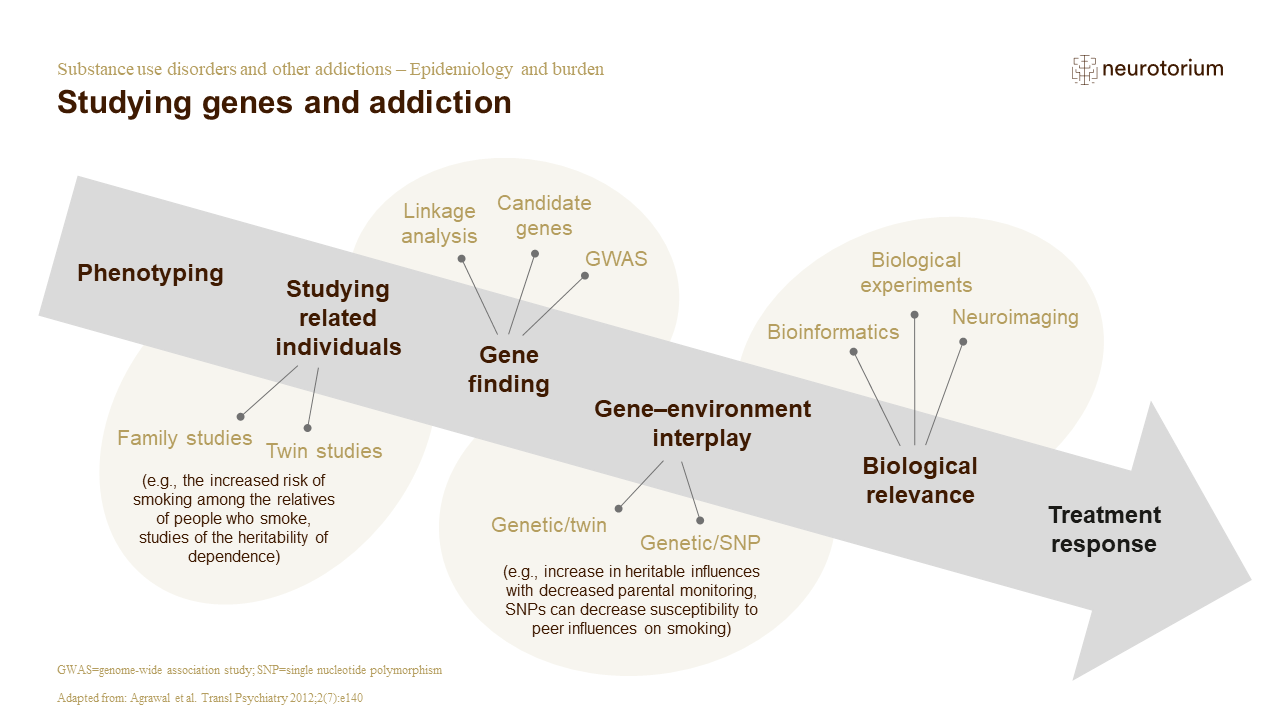
Studying the genetics of addiction and addictive disorders is complex. The criteria for use, abuse, and dependence are historically complicated, and have at times been partly overlapping – although this situation has improved with the DSM-5.[1,2,3] A second complication is the degree of comorbidity between addictive disorders and other mental conditions, which are therefore presumed to share some degree of underlying causative factors.[3] Lastly, because individuals exist in a social context, the influences of their genetics interact with the environment.[3] Consider a person with genes predisposing them to grow very tall but who is malnourished as a child – or in the context of addiction, a person with a genetic tendency towards substance-use disorder, but who is never exposed to addictive substances in their lifetime.[3]
References:
[1] Agrawal A, Verweij KJH, Gillespie NA, et al. The genetics of addiction – a translational perspective. Transl Psychiatry 2012; 2 (7): e140.