

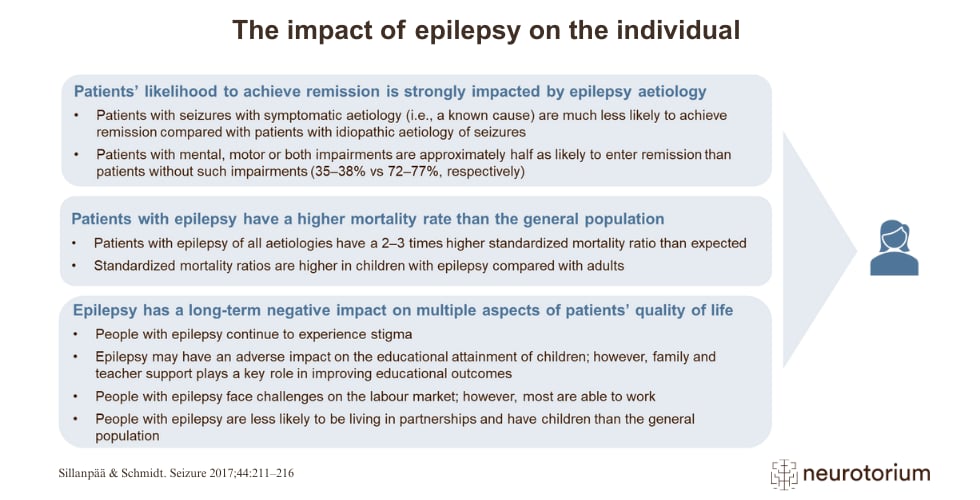
The figure summarizes how epilepsy affects individuals throughout their life course. The review of the long-term outcomes for patients receiving treatment for epilepsy concluded that for the vast majority of people with new-onset epilepsy, the outlook is very good: most will become permanently seizure free on and off drugs, mostly within a few years of pharmacological treatment, and another important minority will have long periods of seizure remission interspersed with a few episodes.1 In addition, social support for and attitudes towards people with epilepsy have improved in the past few decades.1 However, challenges remain, since a substantial minority of patients have epilepsy that is resistant to treatment, and mortality and sudden unexplained death in epilepsy (SUDEP) are still major concerns.1
Related content
In this video, Professor Dr. Nathalie Jetté reviews depression as a common yet often under-recognized comorbidity in epilepsy.
In this video, Professor Dr. Gretchen Birbeck examines epilepsy-associated stigma as a global public-health challenge
In this video, Professor Dr. Jacqueline French reviews practical, first-line decision-making for anti-seizure medication selection