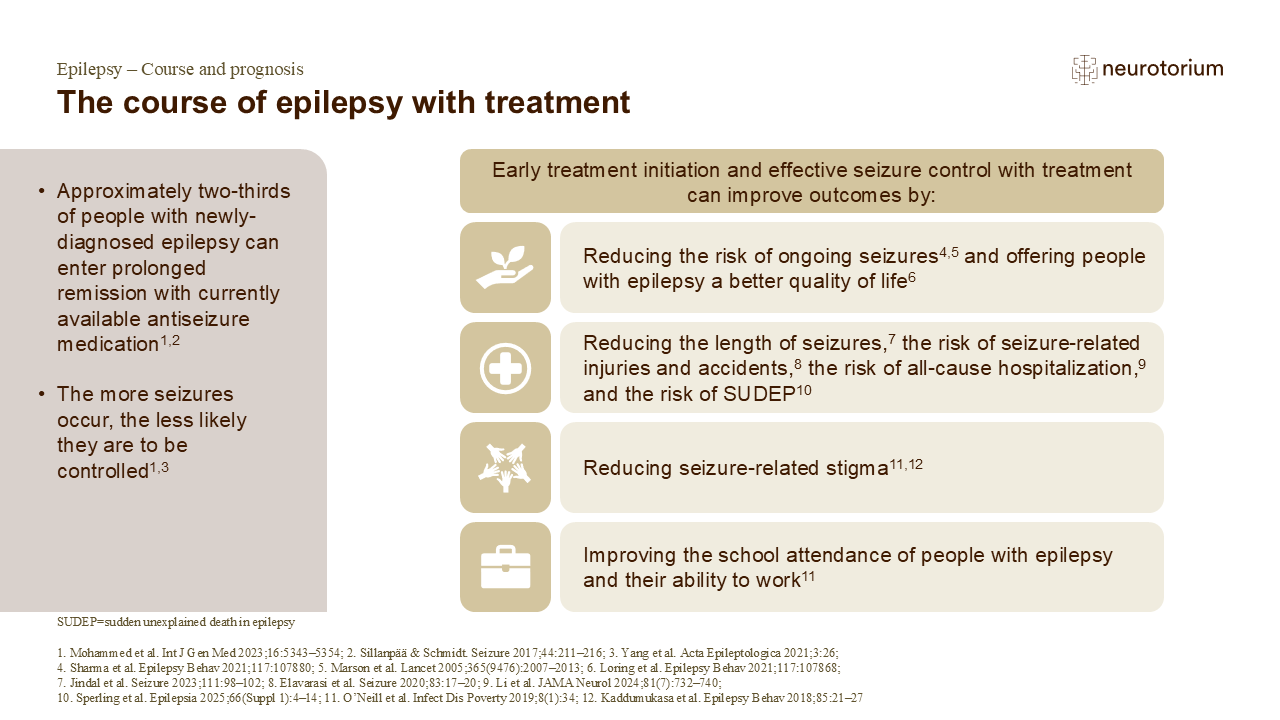
Immediate treatment is associated with lower rates of seizure recurrence and longer time to seizure recurrence than deferred treatment in patients with epilepsy, especially in those who had experienced two or more unprovoked seizures at diagnosis.4,5 However, once treatment commenced, the differences in the rates of patients achieving seizure remission following immediate vs deferred treatment diminish over time.4,5
Apart from treatment timing, correct dosing is also crucial for optimizing outcomes in epilepsy.7
A retrospective observational study evaluating the management and outcomes of status epilepticus in 252 patients at University College Hospital London found the median time to seizure cessation to be 25 minutes, with a positive correlation between time to first benzodiazepine treatment administration and seizure cessation (p<0.05).7 The median time to seizure cessation was 18 minutes in patients who received a correct dose of benzodiazepine treatment, compared with 39 minutes in patients who received either lower or higher doses than recommended by the National Institute for Health and Care Excellence.7 In addition, patients who received benzodiazepine treatment within 15 minutes of status epilepticus onset had a much lower likelihood of requiring second- and third-line treatment, and of experiencing respiratory complications, than patients receiving benzodiazepine treatment after 15 minutes of status epilepticus onset (p<0.05).7 Longer duration of seizures (>30 minutes) was associated with a significantly higher likelihood of respiratory complications than shorter duration of seizures.7
References:
1.Mohammed AS, Mishore KM, Tafesse TB, et al. Seizure remission and its predictors among epileptic patients on follow-up at public hospitals in Eastern Ethiopia: A retrospective cohort study. Int J Gen Med 2023; 16: 5343‒5354.
2.Sillanpää M, Schmidt D. Long-term outcome of medically treated epilepsy. Seizure 2017; 44: 211‒216.
3.Yang H, Zhang J, Yang C, et al. The long-term prognosis and predictors of epilepsy: a retrospective study in 820 patients. Acta Epileptologica 2021; 3: 26.
4.Sharma S, Chen Z, Rychkova M, et al. Short- and long-term outcomes of immediate and delayed treatment in epilepsy diagnosed after one or multiple seizures. Epilepsy Behav 2021; 117: 107880.
5.Marson A, Jacoby A, Johnson A, et al. Immediate versus deferred antiepileptic drug treatment for early epilepsy and single seizures: a randomised controlled trial. Lancet 2005; 365: 2007– 2013.
6.Loring DW, Jarosiewicz B, Meador KJ, et al. Mood and quality of life in patients treated with brain-responsive neurostimulation: The value of earlier intervention. Epilepsy Behav 2021; 117: 107868.
7.Jindal M, Neligan A, Rajakulendran S. Early and established status epilepticus: The impact of timing of intervention, treatment escalation and dosing on outcome. Seizure 2023; 111: 98–102.
8.Elavarasi A, Parihar J, Kapoor S, et al. Seizure-related injuries in inadequately treated epilepsy patients: A case-control study. Seizure 2020; 83: 17–20.
9.Li Y, Ren T, Burgess M, et al. Early access to first-seizure clinics, subsequent outcomes, and factors associated with attendance. JAMA Neurol 2024; 81 (7): 732–740.
10.Sperling MR, Rosenfeld WE, Watson J, Klein P. Seizure freedom and reducing the risk of sudden unexpected death in patients with focal epilepsy treated with cenobamate or other antiseizure medications. Epilepsia 2025; 66 (Suppl 1): 4–14.
11.O’Neill S, Irani J, Fodjo JNS, et al. Stigma and epilepsy in onchocerciasis-endemic regions in Africa: a review and recommendations from the onchocerciasis-associated epilepsy working group. Infect Dis Poverty 2019; 8: 34.
12.Kaddumukasa M, Kaddumukasa MN, Buwembo W, et al. Epilepsy misconceptions and stigma reduction interventions in sub-Saharan Africa, a systematic review. Epilepsy Behav 2018; 85: 21–27.