

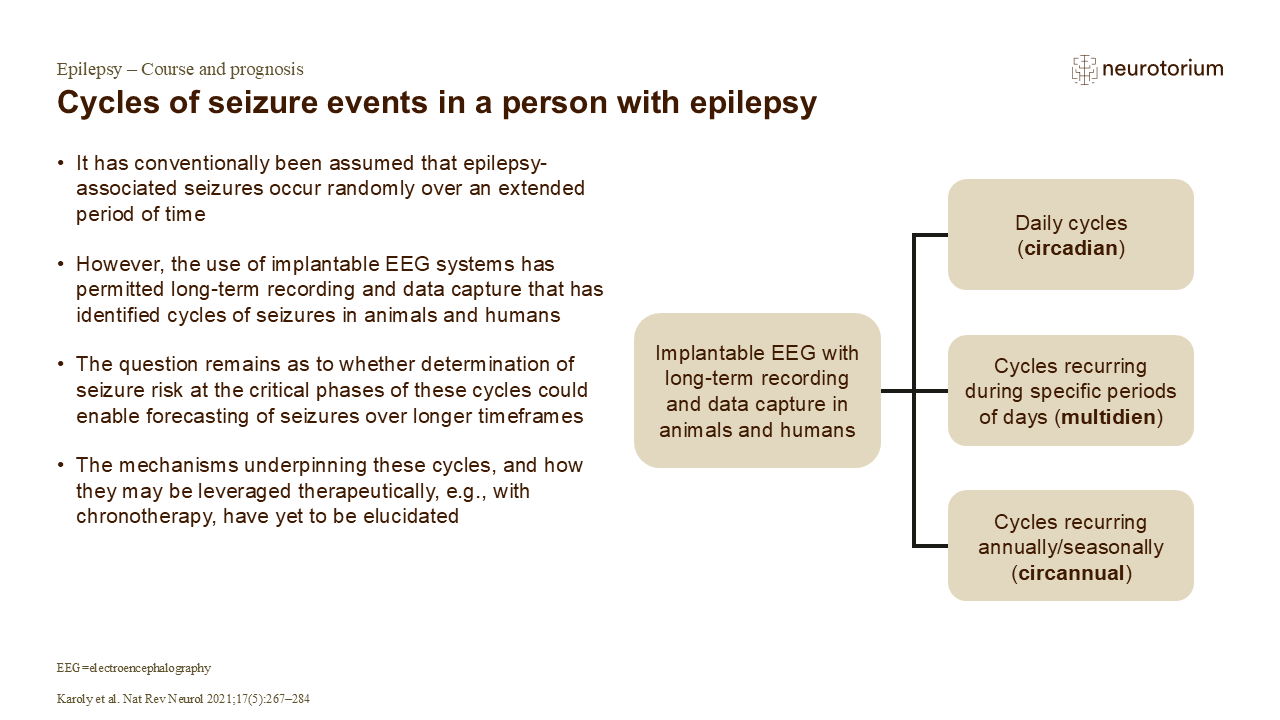
Evidence suggests that the momentary likelihood of a seizure is co-modulated by cycles running on divergent timescales.1 Circadian seizure cycles are the most prevalent (~90%), with peak seizure incidence occurring at specific times of day with substantial variability, but also shared patterns, across individuals (i.e., seizure chronotypes).1 This variability is likely driven by endogenous circadian factors as well as the timing of behaviours such as sleep, eating or taking medication.1 Seizures are more common around sleep-wake transitions, so late evening and/or early morning seizure chronotypes have been observed at the population level.1 People with sleep-related epilepsy can have a peak seizure time soon after falling asleep (typically before midnight) or in late stages of sleep (typically at dawn); these are unlikely to be fully explained by the differential effects of rapid eye movement (REM) and non-REM phases of sleep on seizures.1
EEG data show that individual seizure chronotypes are fairly stable over months or years.1 However, preferential seizure times may spontaneously change, with dramatic practical implications for patients’ day-to-day life.1 Seizure chronotypes may differ between paediatric and adult populations, possibly due to age-dependent differences in sleep–wake cycles or hormonal or behavioural factors, or due to the development of intrinsic circadian regulatory mechanisms in the brain.1
Reference: