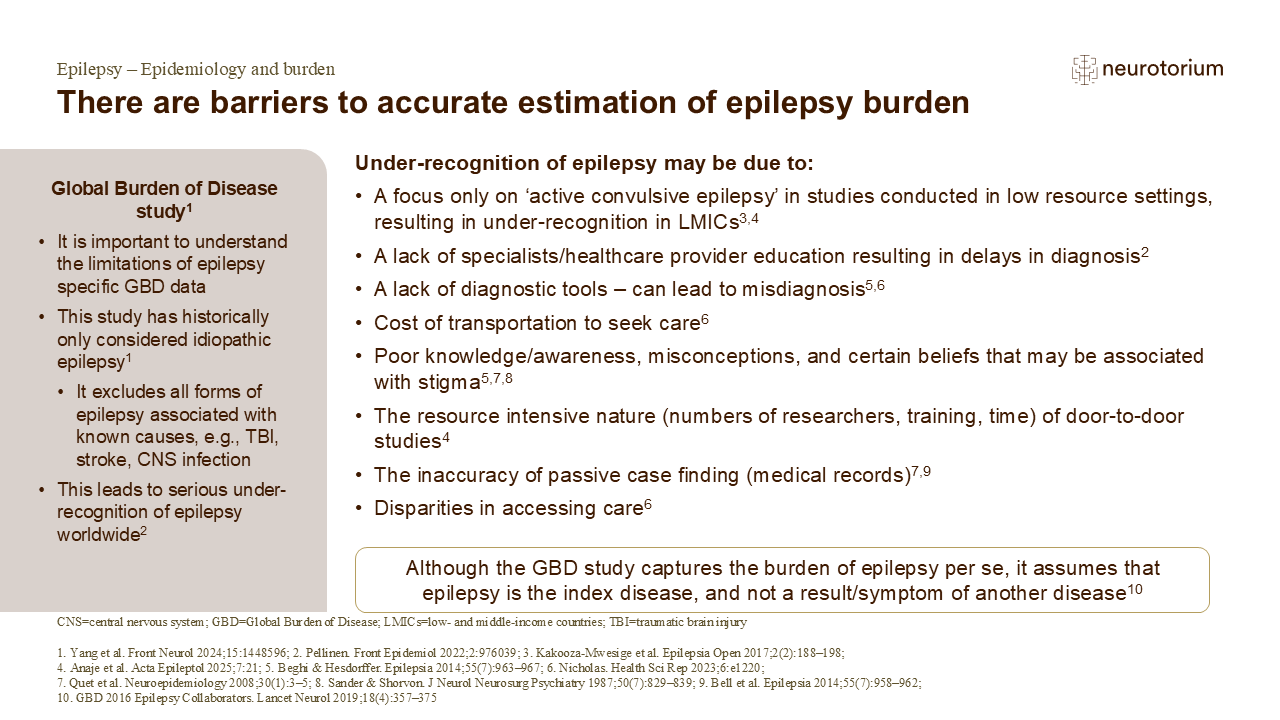
Under-recognition of epilepsy is an issue in low resource settings, with multiple factors involved.2,5,6 From the healthcare system perspective, the diagnosis of epilepsy may be delayed or missed due to inadequate healthcare provider training, and a lack of diagnostic tools such as electroencephalography.2,5,6 From a societal perspective, epilepsy may not be publicly acknowledged due to denial of symptoms, stigma, lack of family support, and costs of transportation to seek care.2,6 Epidemiological studies can use door-to-door survey methods, which while providing valuable data, require the involvement of a large group of researchers who must be trained.3,4 Such surveys may also cover only ‘active convulsive epilepsy’, missing cases of epilepsy where convulsive seizures do not occur.3,4
References:
1.Yang L, Guo Y, Wang Z, Zhang C. A population-based analysis of the global burden of epilepsy across all age groups (1990-2021): utilizing the Global Burden of Disease 2021 data. Front Neurol 2024; 15: 1448596.
2.Pellinen J. Treatment gaps in epilepsy. Front Epidemiol 2022; 2: 976039.
3.Kakooza-Mwesige A, Ndyomugyenyi D, Pariyo G, et al. Adverse perinatal events, treatment gap, and positive family history linked to the high burden of active convulsive epilepsy in Uganda: A population-based study. Epilepsia Open 2017; 2 (2): 188‒198.
4.Anaje OD, Nwani PO, Nwosu MC, et al. Prevalence of active convulsive epilepsy in Dunukofia County in South East Nigeria: a door-to-door survey. Acta Epileptol 2025; 7: 21.
5.Beghi E, Hesdorffer D. Prevalence of epilepsy – an unknown quantity. Epilepsia 2014; 55 (7): 963–967.
6.Nicholas A. Unlocking the hidden burden of epilepsy in Africa: Understanding the challenges and harnessing opportunities for improved care. Health Sci Rep 2023; 6: e1220.
7.Quet F, Odermatt P, Preux P-M. Challenges of epidemiological research on epilepsy in resource-poor countries. Neuroepidemiology 2008; 30 (1): 3–5.
8.Sander JW, Shorvon SD. Incidence and prevalence studies in epilepsy and their methodological problems: a review. J Neurol Neurosurg Psychiatry 1987; 50 (7): 829–839.
9.Bell GS, Neligan A, Sander JW. An unknown quantity – the worldwide prevalence of epilepsy. Epilepsia 2014; 55 (7): 958–962.
10.GBD 2016 Epilepsy Collaborators. Global, regional, and national burden of epilepsy, 1990-2016: a systematic analysis for the Global Burden of Disease Study 2016. Lancet Neurol 2019; 18 (4): 357–375.